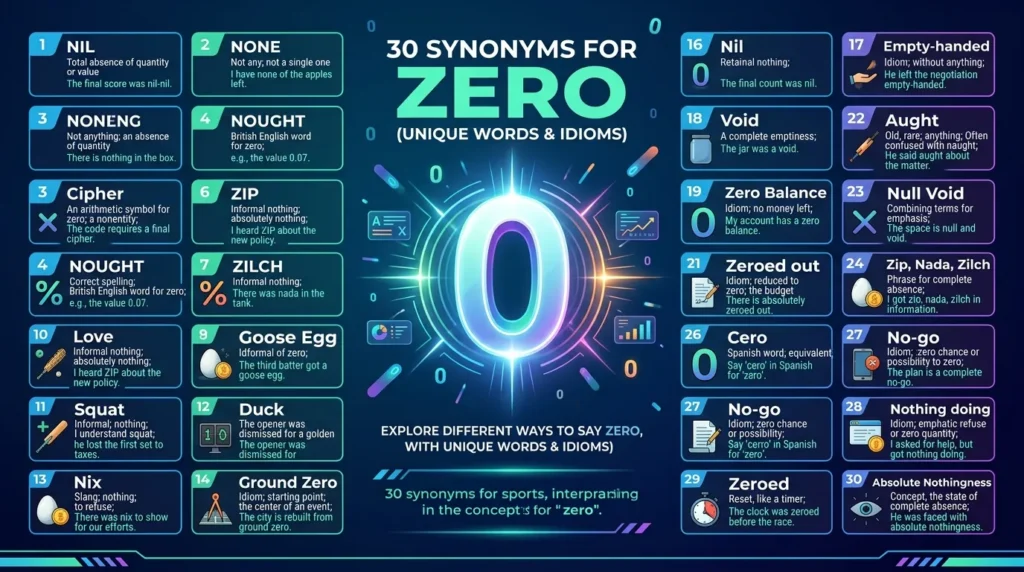
Zero means nothing, no amount, or the number 0. Imagine checking your wallet before buying lunch. You open it and find no money. Your balance is zero. You may also get zero points on a test if you do not answer any questions correctly. Zero is one of the most common numbers in English. It is used in math, money, sports, science, time, and daily speech. Many English learners search for synonyms for zero because they want better ways to say “nothing” or “no amount.” Learning synonyms for zero helps writers avoid using the same word again and again. Synonyms for zero also helps speakers choose the right word for each situation. In this article, we will explore the meaning, history, pronunciation, grammar, and tone of zero. Along with 30 useful synonyms and close alternatives.
Meaning of Zero
Definition
Zero (noun): The number 0, or a complete lack of something.
Examples
- I have zero money in my wallet.
- The answer is zero.
Zero can also work as a verb, adjective, and other word forms in English.
Connotative Meaning
- Positive tone: Zero can suggest a fresh start, such as starting from zero.
- Negative tone: Zero can suggest failure, loss, or a complete lack of something.
- Neutral tone: In math and science, zero is simply the number 0.
Etymology
- Source language: The word zero entered English through French and Italian.
- Italian: zero
- Medieval Latin: zephirum
- Arabic: ṣifr
- Original meaning: “Empty” or “nothing.”
Short History of Zero
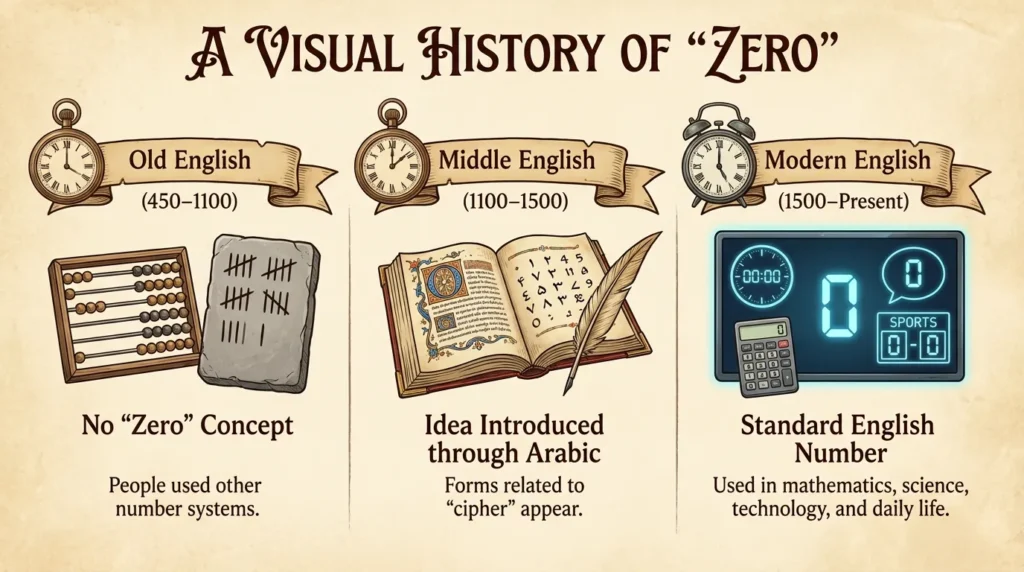
Old English (450–1100):
The word zero was not part of normal Old English. People used other number systems and ideas to show an empty amount.
Middle English (1100–1500):
The idea of zero became more known in Europe through Arabic and mathematical writing. Forms related to cipher and zero began to enter European languages.
Modern English (1500–Present):
Zero became a standard English number. Today, it is used in mathematics, science, technology, money, sports, weather, and daily life.
Pronunciation
US: /ˈzɪroʊ/ UK: /ˈzɪərəʊ/
Syllables
ze-ro
Affixation Pattern of Zero
- Root: zero
- Prefix: none
- Suffix: none
- Word formation: zero is mainly used as a noun. It can also be used as a verb and adjective in modern English.
Common forms include:
- zero — noun
- zeroes — plural noun
- zeroed — verb
- zeroing — verb form
- zero-based — adjective
- zero-point — noun/adjective
- zero-sum — adjective/noun
Also get more information about https://synonymhubb.com/synonyms-for-conversely/
Synonyms for Zero
1. Nil (Noun) — US /nɪl/ | UK /nɪl/
Meaning: Nil means zero or nothing, especially in scores and results.
Examples:
- The final score was two to nil.
- The team lost three to nil.
2. Naught (Noun) — US /nɔːt/ | UK /nɔːt/
Meaning: Naught means zero or nothing and is often used in formal or traditional English.
Examples:
- The temperature fell to naught.
- His effort came to naught.
3. Nought (Noun) — US /nɔːt/ | UK /nɔːt/
Meaning: Nought means zero or nothing and is common in British English.
Examples:
- The score was two to nought.
- Add nought to the number.
4. Nothing (Pronoun/Noun) — US /ˈnʌθɪŋ/ | UK /ˈnʌθɪŋ/
Meaning: Nothing means not anything or no amount.
Examples:
- There is nothing in the box.
- I have nothing to say.
5. Null (Noun/Adjective) — US /nʌl/ | UK /nʌl/
Meaning: Null means having no value, amount, or effect in a special technical context.
Examples:
- The computer returned a null value.
- The result was null.
6. Cipher (Noun) — US /ˈsaɪfər/ | UK /ˈsaɪfə/
Meaning: Cipher can mean zero, especially in older or formal mathematical use.
Examples:
- The old text used a cipher for zero.
- The account showed a cipher balance.
7. Zilch (Noun) — US /zɪltʃ/ | UK /zɪltʃ/
Meaning: Zilch is an informal word for zero or nothing.
Examples:
- I know zilch about cars.
- We earned zilch from the sale.
8. Zip (Noun) — US /zɪp/ | UK /zɪp/
Meaning: Zip is an informal word that means zero or nothing.
Examples:
- He knows zip about the topic.
- We got zip points.
9. Nada (Noun) — US /ˈnɑːdə/ | UK /ˈnɑːdə/
Meaning: Nada is an informal word meaning nothing or zero.
Examples:
- I found nada in the bag.
- We received nada for our work.
10. Goose Egg (Noun) — US /ˈɡuːs eɡ/ | UK /ˈɡuːs eɡ/
Meaning: Goose egg is an informal expression for zero, especially a score of zero.
Examples:
- He got a goose egg in the game.
- The team finished with a goose egg.
11. O (Noun) — US /oʊ/ | UK /əʊ/
Meaning: O can be used as a spoken name for the number zero in some contexts.
Examples:
- The score was one to O.
- The code ends in O.
12. Love (Noun) — US /lʌv/ | UK /lʌv/
Meaning: Love means zero in the scoring system of tennis and some other racket sports.
Examples:
- The score is love–fifteen.
- She won the game from love–forty.
13. Duck (Noun) — US /dʌk/ | UK /dʌk/
Meaning: Duck is informal sports language for a score of zero, especially in cricket.
Examples:
- The batsman was out for a duck.
- He scored a duck in the match.
14. Duck Egg (Noun) — US /ˈdʌk eɡ/ | UK /ˈdʌk eɡ/
Meaning: Duck egg is an informal sports term for a score of zero.
Examples:
- He was dismissed for a duck egg.
- The player ended with a duck egg.
15. Big Zero (Noun) — US /bɪɡ ˈzɪroʊ/ | UK /bɪɡ ˈzɪərəʊ/
Meaning: Big zero is an informal phrase for a complete lack of success or value.
Examples:
- His plan was a big zero.
- The deal brought us a big zero.
16. Round Number (Noun) — US /raʊnd ˈnʌmbər/ | UK /raʊnd ˈnʌmbə/
Meaning: Round number can refer to a number such as zero, although it is not a direct synonym for zero.
Examples:
- The count returned to a round number.
- Zero is a useful round number in math.
17. Empty (Adjective) — US /ˈɛmpti/ | UK /ˈempti/
Meaning: Empty means containing nothing.
Examples:
- The box is empty.
- My account is empty.
18. Vacant (Adjective) — US /ˈveɪkənt/ | UK /ˈveɪkənt/
Meaning: Vacant means empty or not occupied.
Examples:
- The seat was vacant.
- The room was vacant.
19. Void (Noun/Adjective) — US /vɔɪd/ | UK /vɔɪd/
Meaning: Void means an empty space or complete lack of something.
Examples:
- The area was a void.
- The old system left a void.
20. Lack (Noun) — US /læk/ | UK /læk/
Meaning: Lack means not having enough or not having something at all.
Examples:
- There is a lack of food.
- The team suffered from a lack of money.
21. Absence (Noun) — US /ˈæbsəns/ | UK /ˈæbsəns/
Meaning: Absence means that someone or something is not present.
Examples:
- His absence was clear.
- The absence of rain hurt the crops.
22. Devoid (Adjective) — US /dɪˈvɔɪd/ | UK /dɪˈvɔɪd/
Meaning: Devoid means completely without something.
Examples:
- The room was devoid of furniture.
- His speech was devoid of facts.
23. None (Pronoun/Determiner) — US /nʌn/ | UK /nʌn/
Meaning: None means not one or not any.
Examples:
- None of the money was left.
- None of the answers were correct.
24. Nowt (Pronoun/Noun) — US /naʊt/ | UK /naʊt/
Meaning: Nowt is a regional British word meaning nothing.
Examples:
- There was nowt in the box.
- He knows nowt about the subject.
25. Nix (Noun/Verb) — US /nɪks/ | UK /nɪks/
Meaning: Nix is an informal word linked with nothing or stopping something.
Examples:
- We got nix from the deal.
- The plan was nixed by the manager.
26. Sweet Nothing (Noun Phrase) — US /swiːt ˈnʌθɪŋ/ | UK /swiːt ˈnʌθɪŋ/
Meaning: Sweet nothing is an informal phrase meaning nothing of value or importance.
Examples:
- The deal gave us sweet nothing.
- He promised a lot but gave us sweet nothing.
27. Zero Point (Noun) — US /ˈzɪroʊ pɔɪnt/ | UK /ˈzɪərəʊ pɔɪnt/
Meaning: Zero point is a point at which a value is zero.
Examples:
- The scale returned to zero point.
- The machine reached its zero point.
28. No Amount (Noun Phrase) — US /noʊ əˈmaʊnt/ | UK /nəʊ əˈmaʊnt/
Meaning: No amount means that there is zero of something.
Examples:
- There was no amount of money left.
- No amount of effort changed the result.
29. No One (Pronoun) — US /noʊ wʌn/ | UK /nəʊ wʌn/
Meaning: No one means not a single person and can express a count of zero people.
Examples:
- No one came to the meeting.
- No one knew the answer.
30. Nothing at All (Phrase) — US /ˈnʌθɪŋ æt ɔːl/ | UK /ˈnʌθɪŋ ət ɔːl/
Meaning: Nothing at all means absolutely nothing or zero.
Examples:
- There was nothing at all in the box.
- I felt nothing at all after the news.
Prototype Meaning
The most typical meaning of zero is the number 0. When people hear the word zero, they usually think of no amount. For example, zero dollars means no dollars, and zero points means no points. In math, zero is a special number between negative and positive numbers. In daily English, it can also show a complete lack of something. The exact meaning depends on the situation.
Prototype Categorization
The synonyms and close alternatives for zero can be grouped into useful categories:
- Math and numbers: zero, naught, nought, cipher, zero point.
- No amount: nothing, none, no amount, nothing at all.
- Informal words: zilch, zip, nada, nix, goose egg.
- Sports words: nil, love, duck, duck egg, goose egg.
- Empty or missing: empty, vacant, void, lack, absence, devoid.
- Regional or older words: naught, nought, nowt, cipher.
- Special expressions: big zero, sweet nothing, no one.
Antonyms of Zero
- One: the next whole number after zero.
- Something: the opposite of nothing.
- Many: a large number.
- Some: an amount greater than zero.
- Full: the opposite of empty.
- Presence: the opposite of absence.
- Plenty: a large or more-than-enough amount.
- Positive number: a number greater than zero.
Short Questions and Answers
- What does zero mean?
- Zero means the number 0 or no amount of something.
- When should zero be used?
- Use zero when talking about the number 0, no amount, or no score.
- Is zero positive or negative?
- Zero is neither positive nor negative in basic mathematics. Its emotional meaning depends on the context.
- How is zero different from nothing?
- Zero is a number. Nothing means not anything. They can have a similar meaning in some sentences.
- What is the most common synonym for zero?
- Nil is a common synonym in some contexts, especially sports. Nothing can also mean zero when talking about an amount.
- Is nil the same as zero?
- Often, yes. It is especially common for scores and amounts in British English.
- Is zilch formal English?
- No. Zilch is informal and is best used in casual speech and writing.
Conclusion
Synonyms for zero gives English learners more ways to express the idea of no amount, no score, or nothing. The word zero is the main and most useful choice because it works in math, science, money, sports, and daily life. However, words such as nil, naught, nought, nothing, none, zilch, and zip can add variety when the situation is right. Some words have special uses. For example, love can mean zero in tennis, while duck can mean zero in cricket. Informal words such as zilch and nada are useful in casual speech but may not fit formal writing. By learning the meaning, pronunciation, tone, history, you can make your English natural. Practice one new synonym each day. This will build your vocabulary, improve your writing and speaking. synonyms for zero reduce repetition, and give you more confidence in English.

I’m Zahid Abbas, an educator, researcher, and digital publishing strategist with a passion for linguistics, grammar, and clear communication. As a content creator and SEO specialist, I craft research-driven, reader-focused content that empowers learners and makes knowledge accessible worldwide.