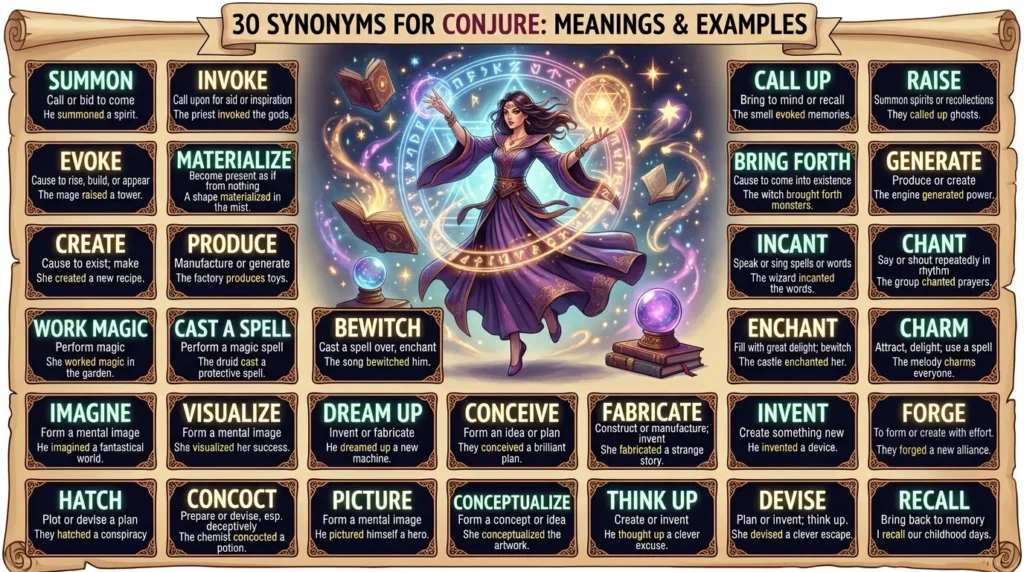
The word conjure means to summon something as if by magic or to bring a vivid picture, image, or memory into the mind. Imagine watching a magician wave a wand and pull a white rabbit right out of an empty black hat that magician just conjured a rabbit. In everyday life, you might smell freshly baked cookies. And suddenly conjure up happy memories of visiting your grandmother. People use synonyms for conjure storytelling, creative writing, and history. Learning synonyms for conjure helps writers, students, and learners describe imagination and memory without repeating the same term. This complete guide covers the full meaning of conjure. Its history, pronunciations, grammar rules. Along thirty useful synonyms for conjure with example sentences and helpful categories.
Meaning of Conjure
Definition
Conjure (Verb): To call upon or summon a spirit or magic spell; to bring an image, memory. An idea vividly into the mind; to produce or cause something to appear unexpectedly.
Examples
- The scent of lavender can conjure fond memories of summer childhood trips.
- The illusionist managed to conjure a flock of doves from an empty box.
Connotative Meaning
- Positive tone:
- Represents creativity, rich imagination, wonderful memories, artistic skill, and delightful surprises.
- Negative tone:
- Can imply deception, dark magic, witchcraft, or inventing false stories out of thin air.
- Neutral tone:
- Describes evoking a thought, calling a witness under oath, or creating a visual effect.
Etymology
- Source language:
- Comes from Old French conjurer, derived from Latin coniurare (meaning to swear together).
- Old English (450–1100):
- Early speakers used Germanic terms like gecleopian (to call upon) or galdrian (to enchant or practice incantations).
- Middle English (1100–1500):
- Adopted through Middle French conjurer to mean appealing to someone under oath or constraining spirits by sacred names.
- Modern English (1500–Present):
- Expanded to describe stage magic, pulling things out of nowhere, and evoking vivid thoughts., or feelings.
Pronunciation
- US: /ˈkɑːndʒər/
- UK: /ˈkʌndʒə/
Syllables
con-jure (2 parts)
Affixation Pattern of Conjure
- Root: Conjure
- Prefix: Con- (together / thoroughly)
- Suffix: -er (Conjurer), -ation (Conjuration)
- Word Formation:
- Noun: Conjuration / Conjurer / Conjuror
- Verb: Conjure
- Adjective: Conjuring
- Adverb: Conjuringly
Discover more about https://synonymhubb.com/synonyms-for-attribute/
Synonyms for Conjure
1. Summon (Verb) — US: /ˈsʌmən/ | UK: /ˈsʌmən/
Meaning: To call people, spirits, or memories into presence.
Examples:
The king decided to summon his royal advisors.
She had to summon all her courage to speak.
2. Evoke (Verb) — US: /ɪˈvoʊk/ | UK: /ɪˈvəʊk/
Meaning: To bring a feeling, memory, or image into the conscious mind.
Examples:
Old songs often evoke powerful emotions.
The painting helps evoke a peaceful feeling.
3. Invoke (Verb) — US: /ɪnˈvoʊk/ | UK: /ɪnˈvəʊk/
Meaning: To call on a higher power, law, or spirit for help.
Examples:
Ancient priests would invoke the gods for rain.
The lawyer chose to invoke a special legal rule.
4. Produce (Verb) — US: /prəˈduːs/ | UK: /prəˈdjuːs/
Meaning: To cause something to appear or be made.
Examples:
The chef can produce a delicious meal in minutes.
He managed to produce the missing keys from his pocket.
5. Raise (Verb) — US: /reɪz/ | UK: /reɪz/
Meaning: To cause thoughts, spirits, or questions to come up.
Examples:
The old legends tell stories of wizards who raise spirits.
Her sudden arrival helped raise new hopes.
6. Materialize (Verb) — US: /məˈtɪriəlaɪz/ | UK: /məˈtɪəriəlaɪz/
Meaning: To appear suddenly in physical form.
Examples:
A figure seemed to materialize out of the thick fog.
Our travel plans failed to materialize this year.
7. Generate (Verb) — US: /ˈdʒɛnəreɪt/ | UK: /ˈdʒenəreɪt/
Meaning: To bring something into existence or create it.
Examples:
The wind turbine helps generate clean electricity.
Good ideas generate enthusiasm among team members.
8. Create (Verb) — US: /kriːˈeɪt/ | UK: /kriːˈeɪt/
Meaning: To bring something new into being.
Examples:
Artists use color to create beautiful landscapes.
The author managed to create a fascinating world.
9. Invent (Verb) — US: /ɪnˈvɛnt/ | UK: /ɪnˈvent/
Meaning: To produce or design something that did not exist before.
Examples:
Engineers work hard to invent helpful tools.
He tried to invent a clever excuse for being late.
10. Imagine (Verb) — US: /ɪˈmædʒɪn/ | UK: /ɪˈmædʒɪn/
Meaning: To form a mental image or concept of something.
Examples:
Children love to imagine flying in space.
Can you imagine living on a tropical island?
11. Envision (Verb) — US: /ɛnˈvɪʒən/ | UK: /ɪnˈvɪʒən/
Meaning: To picture something in your mind as a future possibility.
Examples:
Leaders envision a brighter future for the town.
She could envision the final design clearly.
12. Visualize (Verb) — US: /ˈvɪʒuəlaɪz/ | UK: /ˈvɪʒuəlaɪz/
Meaning: To form a distinct picture of something in your mind.
Examples:
Athletes visualize winning before starting the race.
Try to visualize the route on a map.
13. Recall (Verb) — US: /rɪˈkɔːl/ | UK: /rɪˈkɔːl/
Meaning: To bring a fact or memory back into your mind.
Examples:
I cannot recall where I left my coat.
The old photograph helped her recall her childhood.
14. Recollect (Verb) — US: /ˌrɛkəˈlɛkt/ | UK: /ˌrekəˈlekt/
Meaning: To remember or call back to mind with effort.
Examples:
He tried to recollect the events of that morning.
She could barely recollect his name.
15. Call up (Verb Phrase) — US: /kɔːl ʌp/ | UK: /kɔːl ʌp/
Meaning: To bring something to mind or request presence.
Examples:
This melody will call up sweet memories.
The coach will call up new players for the game.
16. Rouse (Verb) — US: /raʊz/ | UK: /raʊz/
Meaning: To awaken, stir up, or bring out strong feelings.
Examples:
The speech helped rouse the crowd into action.
Bright lights began to rouse him from sleep.
17. Stir (Verb) — US: /stɜːr/ | UK: /stɜː/
Meaning: To excite, awaken, or cause strong emotions.
Examples:
The story began to stir deep feelings in the audience.
A light breeze started to stir the leaves.
18. Elicit (Verb) — US: /ɪˈlɪsɪt/ | UK: /ɪˈlɪsɪt/
Meaning: To draw out a response, answer, or fact.
Examples:
Her funny joke failed to elicit a smile from him.
Teachers ask questions to elicit student thoughts.
19. Fabricate (Verb) — US: /ˈfæbrɪkeɪt/ | UK: /ˈfæbrɪkeɪt/
Meaning: To construct, invent, or make up a false story.
Examples:
Don’t fabricate stories to escape trouble.
Factory workers fabricate metal parts daily.
20. Contrive (Verb) — US: /kənˈtraɪv/ | UK: /kənˈtraɪv/
Meaning: To create or bring about an object or plan by clever skill.
Examples:
They managed to contrive a clever escape plan.
She tried to contrive a meeting with her mentor.
21. Device (Verb / Form of Devise) — US: /dɪˈvaɪz/ | UK: /dɪˈvaɪz/
Meaning: To plan or invent a complex system or idea.
Examples:
Engineers must devise a way to save power.
The team will devise a new strategy.
22. Manufacture (Verb) — US: /ˌmænjəˈfæk tʃər/ | UK: /ˌmænjʊˈfæk tʃə/
Meaning: To make or produce something in large quantities or invent untruths.
Examples:
Companies manufacture cars in large plants.
He tried to manufacture an excuse.
23. Hatch (Verb) — US: /hætʃ/ | UK: /hætʃ/
Meaning: To create a secret plan or bring forth from an egg.
Examples:
The birds wait for their eggs to hatch.
The villains tried to hatch a sly plot.
24. Command (Verb) — US: /kəˈmænd/ | UK: /kəˈmɑːnd/
Meaning: To order with authority or compel to appear.
Examples:
The general can command his troops to move.
Her impressive presence can command respect.
25. Adjure (Verb) — US: /əˈdʒʊr/ | UK: /əˈdʒʊə/
Meaning: To urge or command someone solemnly or under oath.
Examples:
The judge will adjure the witness to tell the truth.
I adjure you to keep this secret safe.
26. Exorcise (Verb) — US: /ˈɛksɔːrsaɪz/ | UK: /ˈeksɔːsaɪz/
Meaning: To drive out or summon away evil spirits by magical or religious ritual.
Examples:
The priest arrived to exorcise the dark spirit.
Writing helped her exorcise her fears.
27. Bewitch (Verb) — US: /bɪˈwɪtʃ/ | UK: /bɪˈwɪtʃ/
Meaning: To cast a spell over someone or charm them completely.
Examples:
The storyteller managed to bewitch the children.
Her graceful dance seemed to bewitch the audience.
28. Enchant (Verb) — US: /ɪnˈtʃænt/ | UK: /ɪnˈtʃɑːnt/
Meaning: To fill someone with delight or place under a spell.
Examples:
The cozy cottage will enchant any traveler.
Witches in fairy tales enchant apples.
29. Charm (Verb) — US: /tʃɑːrm/ | UK: /tʃɑːm/
Meaning: To delight greatly or use magic power.
Examples:
His warm personality can charm anyone.
Snake charmers seem to charm dangerous cobras.
30. Formulate (Verb) — US: /ˈfɔːrmjuleɪt/ | UK: /ˈfɔːmjʊleɪt/
Meaning: To create or prepare a plan or idea systematically.
Examples:
Scientists formulate new theories after testing.
We must formulate a strong plan today.
Prototype Meaning
When people hear conjure, they usually picture a magician performing on stage. Wearing a cape, waving a magic wand, and mysteriously bringing a rabbit, dove, or coin out of thin air. People picture a storyteller bringing a vivid magical scene to life in someone’s mind.
Prototype Categorization
- Magic, Summoning & Spells:
- Summon, Invoke, Adjure, Exorcise, Bewitch, Enchant, Charm, Materialize, Raise.
- Memory & Mental Evocation:
- Evoke, Imagine, Envision, Visualize, Recall, Recollect, Call up, Rouse, Stir, Elicit.
- Creation, Invention & Fabrication:
- Produce, Generate, Create, Invent, Fabricate, Contrive, Devise, Manufacture, Hatch, Formulate.
- Authority & Command:
- Command.
Antonyms of Conjure
- Banish
- Repress
- Suppress
- Forget
- Destroy
- Dispel
Short Questions and Answers
- What does conjure mean?
- It means summoning something through magic, bringing a memory to mind. Also creating something unexpectedly.
- When should conjure be used?
- Use it when describing magic tricks, summoning spirits in stories. Explaining how a scent or sound brought back a vivid memory.
- Is conjure positive or negative?
- It depends on context. It is positive when evoking fond memories or magical wonder. But negative when referring to dark magic or fabricating lies.
- How is conjure different from evoke?
- Conjure often carries a sense of magic, trickery, or pulling something out of nowhere. While evoke focuses specifically on naturally drawing out feelings, memories, or responses.
Conclusion
Synonyms for conjure will enrich your writing and conversation. Relying solely on basic terms like “make” or “remember” can make your descriptions feel plain. Using precise synonyms like materialize for magical appearances, evoke for cherished memories, or devise for clever plans makes your prose engaging. Try incorporating a few synonyms for conjure into your next English essay or story. English learners and content writers can improve their vocabulary, writing, and speaking skills by learning synonyms for conjure.

I’m Zahid Abbas, an educator, researcher, and digital publishing strategist with a passion for linguistics, grammar, and clear communication. As a content creator and SEO specialist, I craft research-driven, reader-focused content that empowers learners and makes knowledge accessible worldwide.