The word drugs refers to substances used for medical treatment, health improvement, or sometimes harmful recreational use. Imagine a person visiting a doctor with a fever. The doctor gives medicine to help the patient recover. Those medicines are commonly called drugs in medical language.
People use this word often in healthcare, science, education, law, and daily conversation. It is an important English word because it can describe both helpful medicines and dangerous substances. Learning synonyms of drugs helps English learners improve vocabulary and understand different contexts more clearly. It also helps writers avoid repetition and choose accurate words for formal, medical, or casual writing.
In this article, you will learn the meaning of drugs, their pronunciation, history, grammar, and 30 useful synonyms with examples, categories, antonyms, and simple explanations.
Meaning of Drugs
Definition
Drugs (noun): substances used for medical treatment or substances that affect the body and mind.
Examples
- The doctor prescribed drugs for the infection.
- Some drugs can be dangerous if misused.
Connotative Meaning
(Connotation means the feeling or emotion a word suggests beyond its basic meaning.)
- Positive tone: healing, treatment, recovery
- Negative tone: addiction, danger, illegal use
- Neutral tone: chemical or medical substances
Etymology
- From Old French drogue meaning “medicine” or “chemical substance”
- Entered English during the Middle Ages
Short History:
- Old English (450–1100): herbal remedies were common
- Middle English (1100–1500): drug-related trade expanded
- Modern English (1500–Present): “drugs” became common in medicine and law
Pronunciation (US & UK – IPA)
- US: /drʌɡz/
- UK: /drʌɡz/
Syllables
- drugs
Affixation Pattern of Drugs
- Root: drug
- Prefix: none
- Suffix: -s
Word Formation:
- drug (noun)
- drugs (noun plural)
- drugged (adjective/verb)
- drugging (verb)
- drugstore (noun)
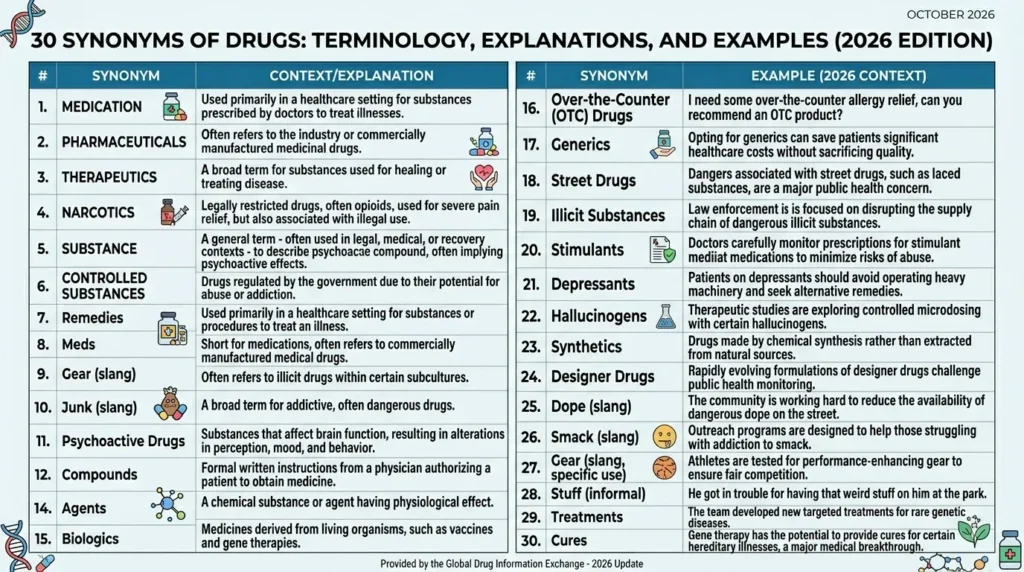
Synonyms of Drugs
1. Medicine (noun)
US: /ˈmedɪsɪn/ | UK: /ˈmedsən/
Meaning: a substance used to treat illness
Examples:
- She took medicine for her cold.
- The doctor prescribed strong medicine.
2. Medication (noun)
US: /ˌmedɪˈkeɪʃən/ | UK: /ˌmedɪˈkeɪʃən/
Meaning: medical treatment using drugs
Examples:
- His medication helped him recover.
- The nurse prepared the medication.
3. Pharmaceutical (noun/adjective)
US: /ˌfɑːrməˈsuːtɪkəl/ | UK: /ˌfɑːməˈsjuːtɪkəl/
Meaning: a medicinal product or related to medicine
Examples:
- Pharmaceutical research saves lives.
- The company produces pharmaceuticals.
4. Remedy (noun)
US: /ˈremədi/ | UK: /ˈremədi/
Meaning: something that cures or improves health
Examples:
- Honey is a natural remedy.
- The remedy worked quickly.
5. Cure (noun)
US: /kjʊr/ | UK: /kjʊə/
Meaning: a treatment that removes disease
Examples:
- Scientists searched for a cure.
- The medicine became a cure.
6. Treatment (noun)
US: /ˈtriːtmənt/ | UK: /ˈtriːtmənt/
Meaning: medical care for illness
Examples:
- Cancer treatment can take months.
- She received treatment yesterday.
7. Prescription (noun)
US: /prɪˈskrɪpʃən/ | UK: /prɪˈskrɪpʃən/
Meaning: medicine ordered by a doctor
Examples:
- The pharmacist filled the prescription.
- You need a prescription for this drug.
8. Tablet (noun)
US: /ˈtæblət/ | UK: /ˈtæblət/
Meaning: a small solid medicine
Examples:
- He swallowed the tablet.
- The tablets reduced pain.
9. Pill (noun)
US: /pɪl/ | UK: /pɪl/
Meaning: a small round medicine
Examples:
- She took a sleeping pill.
- The doctor gave him pills.
10. Capsule (noun)
US: /ˈkæpsjuːl/ | UK: /ˈkæpsjuːl/
Meaning: medicine inside a small container
Examples:
- Take one capsule daily.
- The capsule dissolved quickly.
11. Antibiotic (noun)
US: /ˌæntibaɪˈɑːtɪk/ | UK: /ˌæntibaɪˈɒtɪk/
Meaning: medicine that fights bacteria
Examples:
- The doctor prescribed antibiotics.
- Antibiotics treated the infection.
12. Sedative (noun)
US: /ˈsedətɪv/ | UK: /ˈsedətɪv/
Meaning: a drug that calms people
Examples:
- The patient received a sedative.
- Sedatives help reduce anxiety.
13. Narcotic (noun)
US: /nɑːrˈkɑːtɪk/ | UK: /nɑːˈkɒtɪk/
Meaning: a strong pain-relieving or illegal drug
Examples:
- Narcotics require careful control.
- Police found illegal narcotics.
14. Stimulant (noun)
US: /ˈstɪmjələnt/ | UK: /ˈstɪmjʊlənt/
Meaning: a substance that increases activity
Examples:
- Coffee is a mild stimulant.
- The stimulant increased energy.
15. Substance (noun)
US: /ˈsʌbstəns/ | UK: /ˈsʌbstəns/
Meaning: a type of material or chemical
Examples:
- The substance affected the brain.
- Dangerous substances were removed.
16. Chemical (noun)
US: /ˈkemɪkəl/ | UK: /ˈkemɪkəl/
Meaning: a substance produced by chemistry
Examples:
- Some chemicals are harmful.
- The lab tested the chemical.
17. Tonic (noun)
US: /ˈtɑːnɪk/ | UK: /ˈtɒnɪk/
Meaning: medicine that improves strength
Examples:
- The doctor suggested a tonic.
- Herbal tonics are popular.
18. Elixir (noun)
US: /ɪˈlɪksər/ | UK: /ɪˈlɪksə/
Meaning: a medicinal liquid
Examples:
- The cough elixir tasted sweet.
- He bought a herbal elixir.
19. Injection (noun)
US: /ɪnˈdʒekʃən/ | UK: /ɪnˈdʒekʃən/
Meaning: medicine put into the body with a needle
Examples:
- She received an injection.
- The injection reduced pain.
20. Vaccine (noun)
US: /vækˈsiːn/ | UK: /ˈvæksiːn/
Meaning: medicine that prevents disease
Examples:
- Children received vaccines.
- The vaccine protected people.
21. Painkiller (noun)
US: /ˈpeɪnˌkɪlər/ | UK: /ˈpeɪnˌkɪlə/
Meaning: medicine that reduces pain
Examples:
- He took a painkiller.
- Painkillers eased her headache.
22. Anesthetic (noun)
US: /ˌænəsˈθetɪk/ | UK: /ˌænəsˈθetɪk/
Meaning: a drug that blocks pain
Examples:
- The dentist used an anesthetic.
- The patient received anesthesia.
23. Hallucinogen (noun)
US: /həˈluːsənədʒən/ | UK: /həˈluːsɪnədʒən/
Meaning: a drug causing false sensations
Examples:
- Hallucinogens affect the mind.
- Some hallucinogens are illegal.
24. Ointment (noun)
US: /ˈɔɪntmənt/ | UK: /ˈɔɪntmənt/
Meaning: medicine spread on the skin
Examples:
- Apply the ointment carefully.
- The ointment healed the rash.
25. Serum (noun)
US: /ˈsɪrəm/ | UK: /ˈsɪərəm/
Meaning: a medical liquid used in treatment
Examples:
- Doctors tested the serum.
- The serum improved recovery.
26. Antidote (noun)
US: /ˈæntɪdoʊt/ | UK: /ˈæntɪdəʊt/
Meaning: a substance that stops poison effects
Examples:
- The antidote saved the patient.
- Scientists developed an antidote.
27. Supplement (noun)
US: /ˈsʌplɪmənt/ | UK: /ˈsʌplɪmənt/
Meaning: something added for health improvement
Examples:
- She takes vitamin supplements.
- Supplements improved his diet.
28. Herb (noun)
US: /ɜːrb/ | UK: /hɜːb/
Meaning: a plant used for medicine or flavor
Examples:
- Mint is a useful herb.
- Herbs are common in natural medicine.
29. Potion (noun)
US: /ˈpoʊʃən/ | UK: /ˈpəʊʃən/
Meaning: a medicinal or magical liquid
Examples:
- The story mentioned a healing potion.
- The potion smelled strange.
30. Compound (noun)
US: /ˈkɑːmpaʊnd/ | UK: /ˈkɒmpaʊnd/
Meaning: a chemical mixture
Examples:
- Scientists studied the compound.
- The compound became a new medicine.
Prototype Meaning
The most common meaning of drugs is substances used to treat illness or affect the body and mind. People usually imagine medicines from hospitals, pharmacies, or chemicals connected to health and disease.
Prototype Categorization
- Medical treatments: medicine, remedy, cure, treatment
- Forms of medicine: tablet, capsule, injection, ointment
- Scientific substances: chemical, compound, serum
- Controlled or strong substances: narcotic, sedative, hallucinogen
Categorization helps writers choose the best synonym based on medical, scientific, or social context.
Antonyms of Drugs
Antonyms
- Natural remedy (noun): healing without chemical medicine
- Sobriety (noun): freedom from drugs or alcohol
- Health (noun): physical and mental wellness
- Wellness (noun): healthy condition of body and mind
- Purity (noun): freedom from harmful substances
Short Questions and Answers
What does drugs mean?
- It means substances used for medical treatment or substances affecting the body and mind.
When should drugs be used?
- Use it in medical, scientific, or health-related discussions.
Is drugs positive or negative?
- It can be positive in medicine and negative when linked to illegal use.
How is it different from similar words?
- “Drugs” is broader, while “medicine” mainly refers to helpful treatment.
Conclusion
Learning synonyms of drugs and synonyms of drugs improves vocabulary and communication skills. It helps English learners understand medical, scientific, and social language more clearly. Using different synonyms also avoids repetition and improves writing quality.These words are useful in healthcare, education, research, and everyday conversation. They help writers describe treatments, chemicals, and health conditions accurately. Practice learning and using new vocabulary daily. Small vocabulary improvements can make English communication stronger, clearer, and more confident over time.

I’m Zahid Abbas, an educator, researcher, and digital publishing strategist with a passion for linguistics, grammar, and clear communication. As a content creator and SEO specialist, I craft research-driven, reader-focused content that empowers learners and makes knowledge accessible worldwide.