The word stuff is one of the most common words in English. People use it every day to talk about objects, materials, ideas, or personal belongings. Imagine cleaning your room before guests arrive. You may say, “I need to organize my stuff.” In this sentence, stuff means different things like clothes, books, and small items.
People use this word because it is simple and flexible. However, using the same word too often can make speaking and writing less interesting. Learning synonyms of stuff helps English learners improve vocabulary and communicate more clearly. It also helps writers choose better words for formal, informal, academic, or creative writing. In this article, you will learn the meaning of stuff, its pronunciation, history, grammar, and 30 useful synonyms with meanings, examples, and semantic categories.
Meaning of Stuff
Definition
Stuff (noun/verb): objects, materials, things, or items; to fill something tightly.
Examples
- Please move your stuff from the table.
- She packed all her stuff into a bag.
Connotative Meaning
- Positive tone: useful things, belongings, personal items
- Negative tone: clutter, junk, unnecessary objects
- Neutral tone: general items or materials
Etymology
- From Old French estoffe meaning “material” or “fabric”
- Related to Medieval Latin words meaning “equipment” or “furnishing”
Short History:
- Old English (450–1100): similar words referred to materials and supplies
- Middle English (1100–1500): “stuff” meant cloth, material, or furniture
- Modern English (1500–Present): “stuff” became a general word for objects and things
Pronunciation (US & UK – IPA)
- US: /stʌf/
- UK: /stʌf/
Syllables
- stuff
Affixation Pattern of Stuff
- Root: stuff
- Prefix: none
- Suffix: none
Word Formation:
- stuff (noun)
- stuff (verb)
- stuffed (adjective/verb)
- stuffing (noun)
- stuffy (adjective)
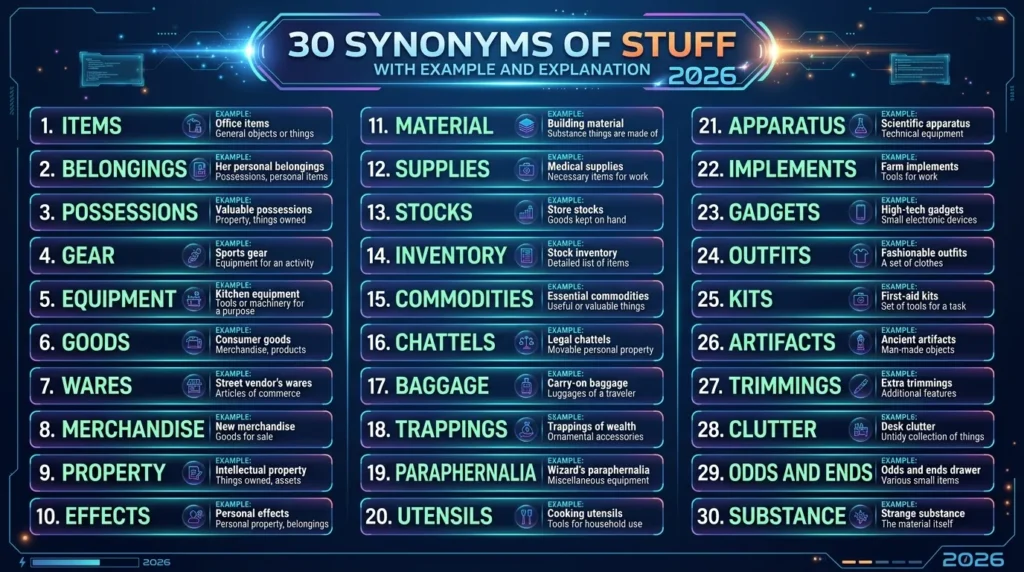
30 Synonyms of Stuff
1. Things (noun)
US: /θɪŋz/ | UK: /θɪŋz/
Meaning: objects or items in general
Examples:
- I packed my things yesterday.
- Her things are on the chair.
2. Items (noun)
US: /ˈaɪtəmz/ | UK: /ˈaɪtəmz/
Meaning: separate objects or pieces
Examples:
- The store sells many items.
- Please list the missing items.
3. Objects (noun)
US: /ˈɑːbdʒekts/ | UK: /ˈɒbdʒekts/
Meaning: physical things that can be seen or touched
Examples:
- Strange objects filled the box.
- The museum displayed ancient objects.
4. Materials (noun)
US: /məˈtɪriəlz/ | UK: /məˈtɪəriəlz/
Meaning: substances used to make things
Examples:
- We bought building materials.
- The teacher shared learning materials.
5. Belongings (noun)
US: /bɪˈlɔːŋɪŋz/ | UK: /bɪˈlɒŋɪŋz/
Meaning: personal possessions
Examples:
- She packed her belongings quickly.
- His belongings were stolen.
6. Possessions (noun)
US: /pəˈzeʃənz/ | UK: /pəˈzeʃənz/
Meaning: things owned by someone
Examples:
- He lost all his possessions.
- Her valuable possessions were safe.
7. Equipment (noun)
US: /ɪˈkwɪpmənt/ | UK: /ɪˈkwɪpmənt/
Meaning: tools or supplies for a purpose
Examples:
- Camping equipment is expensive.
- The gym has new equipment.
8. Gear (noun)
US: /ɡɪr/ | UK: /ɡɪə/
Meaning: equipment or clothing for activities
Examples:
- He packed hiking gear.
- The soldiers carried heavy gear.
9. Supplies (noun)
US: /səˈplaɪz/ | UK: /səˈplaɪz/
Meaning: necessary materials or items
Examples:
- We bought school supplies.
- Food supplies were limited.
10. Goods (noun)
US: /ɡʊdz/ | UK: /ɡʊdz/
Meaning: products or merchandise
Examples:
- The store sells imported goods.
- The truck delivered fresh goods.
11. Junk (noun)
US: /dʒʌŋk/ | UK: /dʒʌŋk/
Meaning: useless or unwanted things
Examples:
- The garage is full of junk.
- He threw away old junk.
12. Clutter (noun)
US: /ˈklʌtər/ | UK: /ˈklʌtə/
Meaning: untidy collection of things
Examples:
- The desk was covered in clutter.
- Too much clutter causes stress.
13. Articles (noun)
US: /ˈɑːrtɪkəlz/ | UK: /ˈɑːtɪkəlz/
Meaning: individual objects or items
Examples:
- Several articles were missing.
- The bag contained personal articles.
14. Merchandise (noun)
US: /ˈmɜːrtʃəndaɪs/ | UK: /ˈmɜːtʃəndaɪs/
Meaning: goods sold in stores
Examples:
- The shop displayed new merchandise.
- Holiday merchandise arrived early.
15. Cargo (noun)
US: /ˈkɑːrɡoʊ/ | UK: /ˈkɑːɡəʊ/
Meaning: goods carried by vehicles
Examples:
- The ship carried heavy cargo.
- Workers unloaded the cargo.
16. Load (noun)
US: /loʊd/ | UK: /ləʊd/
Meaning: amount carried or transported
Examples:
- He carried a heavy load.
- The truck delivered its load.
17. Matter (noun)
US: /ˈmætər/ | UK: /ˈmætə/
Meaning: substance or material
Examples:
- Scientists study dark matter.
- Sticky matter covered the floor.
18. Substance (noun)
US: /ˈsʌbstəns/ | UK: /ˈsʌbstəns/
Meaning: physical material or essence
Examples:
- The bottle held a strange substance.
- Water is a common substance.
19. Contents (noun)
US: /ˈkɑːntents/ | UK: /ˈkɒntents/
Meaning: things inside something
Examples:
- She emptied the bag’s contents.
- The box contents were damaged.
20. Effects (noun)
US: /ɪˈfekts/ | UK: /ɪˈfekts/
Meaning: personal belongings
Examples:
- His personal effects were returned.
- Travelers packed their effects.
21. Kit (noun)
US: /kɪt/ | UK: /kɪt/
Meaning: set of tools or supplies
Examples:
- She bought a sewing kit.
- The first-aid kit was useful.
22. Apparatus (noun)
US: /ˌæpəˈrætəs/ | UK: /ˌæpəˈreɪtəs/
Meaning: equipment or machinery
Examples:
- The lab uses complex apparatus.
- Firefighters checked the apparatus.
23. Stock (noun)
US: /stɑːk/ | UK: /stɒk/
Meaning: stored goods or supplies
Examples:
- The store increased its stock.
- Food stock was running low.
24. Property (noun)
US: /ˈprɑːpərti/ | UK: /ˈprɒpəti/
Meaning: things owned by someone
Examples:
- Personal property was damaged.
- Respect school property.
25. Resources (noun)
US: /ˈriːsɔːrsɪz/ | UK: /rɪˈzɔːsɪz/
Meaning: useful supplies or materials
Examples:
- The team shared learning resources.
- Natural resources are important.
26. Trinkets (noun)
US: /ˈtrɪŋkɪts/ | UK: /ˈtrɪŋkɪts/
Meaning: small decorative objects
Examples:
- She collects tiny trinkets.
- Colorful trinkets filled the shelf.
27. Odds and Ends (noun phrase)
US: /ɑːdz ænd endz/ | UK: /ɒdz ænd endz/
Meaning: small miscellaneous things
Examples:
- The drawer held odds and ends.
- We packed random odds and ends.
28. Ware (noun)
US: /wer/ | UK: /weə/
Meaning: goods or products for sale
Examples:
- The market sold handmade ware.
- Pottery ware was displayed outside.
29. Stuffing (noun)
US: /ˈstʌfɪŋ/ | UK: /ˈstʌfɪŋ/
Meaning: material used to fill something
Examples:
- The pillow lost its stuffing.
- Turkey stuffing smelled delicious.
30. Miscellany (noun)
US: /ˈmɪsəˌleɪni/ | UK: /mɪˈseləni/
Meaning: mixed collection of things
Examples:
- The shelf held a miscellany of objects.
- Her desk contained a strange miscellany.
Prototype Meaning
The most typical meaning of stuff is a general collection of objects, materials, or belongings. People usually imagine clothes, books, tools, or random household items when hearing this word.
Prototype Categorization
- General objects: things, items, objects
- Personal belongings: possessions, belongings, property
- Materials and supplies: materials, resources, supplies
- Unwanted items: junk, clutter, odds and ends
- Professional equipment: gear, apparatus, kit
Antonyms of Stuff
Antonyms
- Nothing (pronoun): absence of anything
- Emptiness (noun): state of having nothing inside
- Void (noun): empty space
- Cleanliness (noun): lack of clutter or mess
- Space (noun): open or empty area
Short Questions and Answers
What does stuff mean?
- It means objects, materials, belongings, or general things.
When should stuff be used?
- Use it in casual conversation when talking about general items or objects.
Is stuff positive or negative?
- It can be positive, negative, or neutral depending on context.
How is it different from similar words?
- “Stuff” is informal and general, while words like “materials” or “possessions” are more specific.
Conclusion
Learning synonyms of stuff and synonyms of stuff improves vocabulary and communication skills. It helps English learners describe objects, belongings, materials, and supplies more clearly in speaking and writing. Using different synonyms also avoids repetition and makes language more natural and professional. These words are useful in everyday conversations, academic writing, business communication, and storytelling. Understanding the different meanings and tones of these synonyms builds stronger English confidence. Practice using new vocabulary daily in sentences and conversations. Small vocabulary improvements can make your English richer, clearer, and more fluent over time.

I’m Zahid Abbas, an educator, researcher, and digital publishing strategist with a passion for linguistics, grammar, and clear communication. As a content creator and SEO specialist, I craft research-driven, reader-focused content that empowers learners and makes knowledge accessible worldwide.