The word awareness means knowing, noticing, or understanding what is happening around you or inside your mind. Imagine waking up in the morning, opening your eyes, and realizing the sun is shining and birds are chirping. That clear state of knowing and paying attention is what we call awareness.
We use awareness when talking about staying alert crossing the street, understanding how someone else feels. Learning new ways to say awareness helps learners make their story writing clear. English learners and content writers need synonyms for awareness too.
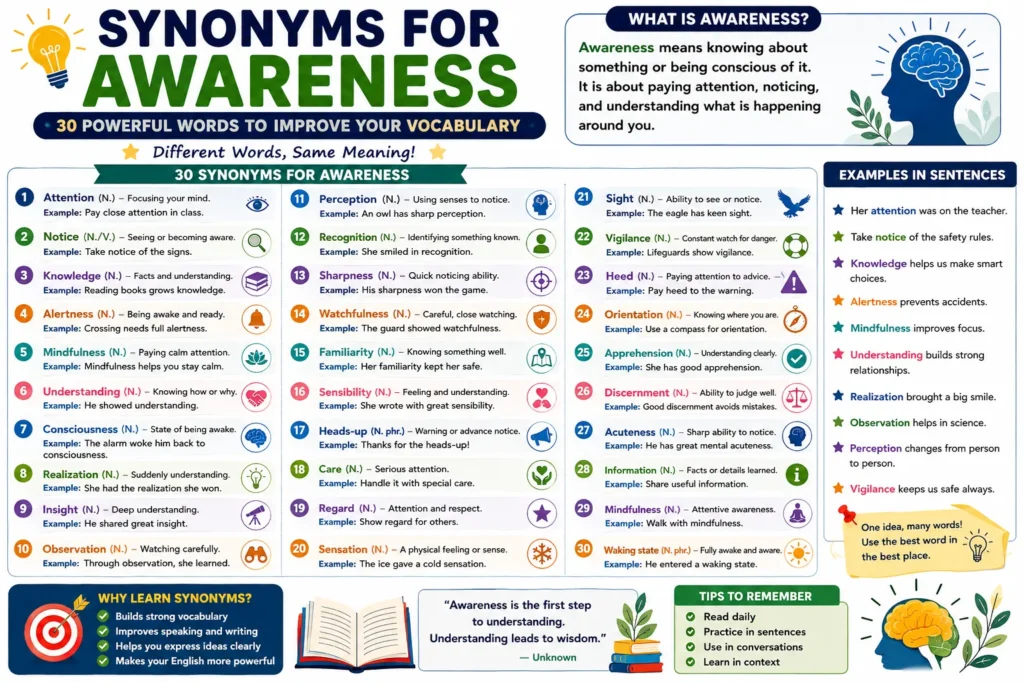
This guide gives you 30 simple synonyms for awareness. Along with easy sentences, word origins, pronunciation guides, and clear categories.
Meaning of Awareness
Definition
Awareness (Noun): Knowledge, understanding, or notice of a situation, fact, or feeling.
Examples
- Raising safety awareness helps children stay safe near roads.
- She showed great awareness by noticing her friend was feeling sad.
Connotative Meaning
- Positive tone: Represents intelligence, mindfulness, safety, alertness, and deep understanding.
- Negative tone: Rarely negative, though being overly aware can sometimes feel overwhelming.
- Neutral tone: Describes simple physical perception or noticing facts.
Etymology
- Source language: Came from Old English roots.
- Old English: Gewær (meaning watchful, wary, or careful).
- Suffix: -ness (added to turn an adjective into a noun describing a state of being).
- Modern English: Literally means the state of being mindful and watchful!
Pronunciation
- US: /əˈwɛrnəs/
- UK: /əˈweənəs/
Syllables
a-ware-ness (3 parts)
Affixation Pattern of Awareness
- Root: Aware (means alert or knowledgeable)
- Suffix: -ness (makes a noun)
- Word Formation:
- Noun: Awareness / Unawareness
- Adjective: Aware / Unaware
- Adverb: Awarely
Synonyms for Awareness
1. Attention (Noun) — US: /əˈtɛnʃn/ | UK: /əˈtenʃn/
Meaning: Focusing your mind closely on someone or something.
Examples:
Pay close attention when the teacher gives directions.
The bright parrot caught everyone’s attention.
2. Notice (Noun / Verb) — US: /ˈnoʊtɪs/ | UK: /ˈnəʊtɪs/
Meaning: Seeing, hearing, or becoming conscious of something.
Examples:
Take notice of the signs posted on the trail.
She gave a quick nod of notice to her brother.
3. Knowledge (Noun) — US: /ˈnɑːlɪdʒ/ | UK: /ˈnɒlɪdʒ/
Meaning: Information and understanding gained through learning or experience.
Examples:
Reading books expands your knowledge about space.
He has great knowledge of forest animals.
4. Alertness (Noun) — US: /əˈlɜːrtnəs/ | UK: /əˈlɜːtnəs/
Meaning: Being awake, active, and ready to notice dangers or changes.
Examples:
Crossing the street requires full alertness.
The guard dog showed high alertness at night.
5. Mindfulness (Noun) — US: /ˈmaɪndflnəs/ | UK: /ˈmaɪndflnəs/
Meaning: Being peaceful and paying calm attention to the present moment.
Examples:
Practicing mindfulness helps students stay calm before tests.
Her mindfulness made her a good listener.
6. Understanding (Noun) — US: /ˌʌndərˈstændɪŋ/ | UK: /ˌʌndəˈstændɪŋ/
Meaning: Knowing how or why something works or how a person feels.
Examples:
He showed a deep understanding of the math problem.
She treated her little sister with warm understanding.
7. Consciousness (Noun) — US: /ˈkɑːnʃəsnəs/ | UK: /ˈkɒnʃəsnəs/
Meaning: The state of being awake and knowing what is happening around you.
Examples:
The loud alarm woke him back to full consciousness.
She lost consciousness for a second after falling down.
8. Realization (Noun) — US: /ˌriːələˈzeɪʃn/ | UK: /ˌrɪəlaɪˈzeɪʃn/
Meaning: Suddenly understanding or figuring something out clearly.
Examples:
The realization that he lost his key made him stop.
She smiled with the realization that she won the race.
9. Insight (Noun) — US: /ˈɪnsaɪt/ | UK: /ˈɪnsaɪt/
Meaning: Deep understanding of a complicated problem or feeling.
Examples:
The science speaker shared great insight on stars.
Her story gave us insight into life long ago.
10. Observation (Noun) — US: /ˌɑːbzərˈveɪʃn/ | UK: /ˌɒbzəˈveɪʃn/
Meaning: Watching or listening carefully to learn something new.
Examples:
Through careful observation, she saw where the bird nested.
His quick observation saved the glass from dropping.
11. Perception (Noun) — US: /pərˈsɛpʃn/ | UK: /pəˈsepʃn/
Meaning: Using your senses to notice and interpret the world.
Examples:
An owl has incredible night-time perception.
Her perception of color helped her paint well.
12. Recognition (Noun) — US: /ˌrɛkəɡˈnɪʃn/ | UK: /ˌrekəɡˈnɪʃn/
Meaning: Identifying a person, place, or fact you knew before.
Examples:
She smiled in recognition when her friend walked in.
His recognition of the road helped us find home.
13. Sharpness (Noun) — US: /ˈʃɑːrpnəs/ | UK: /ˈʃɑːpnəs/
Meaning: Quick thinking and quick noticing skills.
Examples:
His mental sharpness helped him win the chess game.
Her sharpness made her spot small details fast.
14. Watchfulness (Noun) — US: /ˈwɑːtʃflnəs/ | UK: /ˈwɒtʃflnəs/
Meaning: Being careful and keeping a close eye on things.
Examples:
The mother bird kept watchfulness over her chicks.
Camping requires watchfulness around campfires.
15. Familiarity (Noun) — US: /fəˌmɪliˈærəti/ | UK: /fəˌmɪliˈærəti/
Meaning: Knowing something well because you have seen or used it often.
Examples:
Her familiarity with the neighborhood kept her safe.
His familiarity with computers made class easy.
16. Sensibility (Noun) — US: /ˌsɛnsəˈbɪləti/ | UK: /ˌsensəˈbɪləti/
Meaning: The ability to feel, appreciate, or react to emotions and art.
Examples:
She wrote the poem with gentle sensibility.
His musical sensibility was clear when he played piano.
17. Head-up (Noun Phrase) — US: /hɛdz ʌp/ | UK: /hedz ʌp/
Meaning: Informal advance warning or notice about something coming.
Examples:
Thanks for the heads-up about tomorrow’s art supply list.
The teacher gave us a quick heads-up before the bell.
18. Care (Noun) — US: /kɛr/ | UK: /keə/
Meaning: Serious attention or thought paid to avoid harm or mistakes.
Examples:
Handle the glass science cup with special care.
She drew her map with great care and detail.
19. Regard (Noun) — US: /rɪˈɡɑːrd/ | UK: /rɪˈɡɑːd/
Meaning: Paying attention or giving thought and respect to something.
Examples:
He crossed the room with high regard for the rules.
Show regard for others when working in groups.
20. Sensation (Noun) — US: /sɛnˈseɪʃn/ | UK: /senˈseɪʃn/
Meaning: A physical feeling or sense resulting from something touching you.
Examples:
The ice gave her a cold sensation on her hand.
Walking barefoot on grass gives a soft sensation.
21. Sight (Noun) — US: /saɪt/ | UK: /saɪt/
Meaning: The ability to see or the act of noticing visually.
Examples:
The eagle has keen sight across long fields.
The beautiful sunset was a wonderful sight.
22. Vigilance (Noun) — US: /ˈvɪdʒɪləns/ | UK: /ˈvɪdʒɪləns/
Meaning: High alertness and continuous watching for possible danger.
Examples:
Lifeguards show great vigilance at the swimming pool.
Her vigilance prevented the cat from escaping.
23. Heed (Noun) — US: /hiːd/ | UK: /hiːd/
Meaning: Paying close attention or giving serious thought to advice.
Examples:
Pay heed to the warning signs near the river.
He took heed of his mother’s wise words.
24. Orientation (Noun) — US: /ˌɔːriɛnˈteɪʃn/ | UK: /ˌɔːriənˈteɪʃn/
Meaning: Knowing where you are in relation to things around you.
Examples:
Using a compass improves your spatial orientation.
The new student got a tour for campus orientation.
25. Apprehension (Noun) — US: /ˌæprɪˈhɛnʃn/ | UK: /ˌæprɪˈhenʃn/
Meaning: Mental understanding or grasping of an idea or situation.
Examples:
She had a clear apprehension of the science lesson.
His apprehension of the rules was perfect.
26. Discernment (Noun) — US: /dɪˈsɜːrnmənt/ | UK: /dɪˈsɜːnmənt/
Meaning: The ability to judge well, notice fine details, or tell things apart.
Examples:
He showed good discernment in choosing fair friends.
Her discernment helped her pick the best book.
27. Acuteness (Noun) — US: /əˈkjuːtnəs/ | UK: /əˈkjuːtnəs/
Meaning: Sharp perception or keen ability to notice tiny details.
Examples:
Dogs have impressive acuteness in their hearing.
The detective was known for his mental acuteness.
28. Information (Noun) — US: /ˌɪnfərˈmeɪʃn/ | UK: /ˌɪnfəˈmeɪʃn/
Meaning: Facts provided or learned about something or someone.
Examples:
This book contains useful information about rain.
Sharing safety information helps everyone stay well.
29. Mindfulness (Noun) — US: /ˈmaɪndflnəs/ | UK: /ˈmaɪndflnəs/
Meaning: Being attentive, thoughtful, and aware of surroundings.
Examples:
Walking with mindfulness prevents tripping over roots.
Show mindfulness toward your classmates’ feelings.
30. Waking state (Noun Phrase) — US: /ˈweɪkɪŋ steɪt/ | UK: /ˈweɪkɪŋ steɪt/
Meaning: The condition of being fully awake, active, and aware.
Examples:
Your brain stays busy even in a waking state.
He entered a active waking state after breakfast.
Prototype Meaning
When children hear awareness, they picture sitting up straight with bright eyes. Paying close attention to what the anyone is saying, or looking left and right carefully before stepping across a crosswalk.
Also read more about https://synonymhubb.com/synonyms-for-explain/
Prototype Categorization
- Staying Alert & Safe: Alertness, Watchfulness, Vigilance, Sharpness, Attention, Notice.
- Understanding & Knowledge: Knowledge, Understanding, Realization, Insight, Information, Recognition.
- Mind & Feeling States: Consciousness, Mindfulness, Perception, Sensibility, Apprehension, Orientation.
- Careful Observation: Observation, Discernment, Acuteness, Sight, Heed, Regard, Care.
- Clues & Experience: Familiarity, Heads-up, Sensation, Waking state.
Antonyms of Awareness
- Ignorance
- Unconsciousness
- Carelessness
- Inattention
- Forgetfulness
- Neglect
Short Questions and Answers
- What does awareness mean?
- It means knowing, noticing, or understanding facts, feelings, or surroundings.
- When should I use awareness?
- Use it when writing stories about staying safe, paying attention in class, or understanding feelings.
- Is awareness a noun or an adjective?
- It is a noun! (The related adjective is aware).
- How is awareness different from knowledge?
- Awareness means noticing or being conscious of something right now, while knowledge means facts and skills you have learned over time.
Conclusion
Synonyms for awareness can help you talk about knowledge, understanding, and noticing things. Words such as knowledge, understanding, consciousness, recognition, attention, and notice can make your English more varied and natural. Each word has a slightly different meaning, so learning these alternatives helps you choose the best word for each situation. For English learners, synonyms for awareness can improve writing, speaking, reading, and everyday communication. Synonyms for awareness also help you avoid repeating the word awareness too often. Try using a few of these words in simple sentences each day. With regular practice, you can build a stronger vocabulary. Express your ideas clearly, and speak English with greater confidence.

I’m Zahid Abbas, an educator, researcher, and digital publishing strategist with a passion for linguistics, grammar, and clear communication. As a content creator and SEO specialist, I craft research-driven, reader-focused content that empowers learners and makes knowledge accessible worldwide.