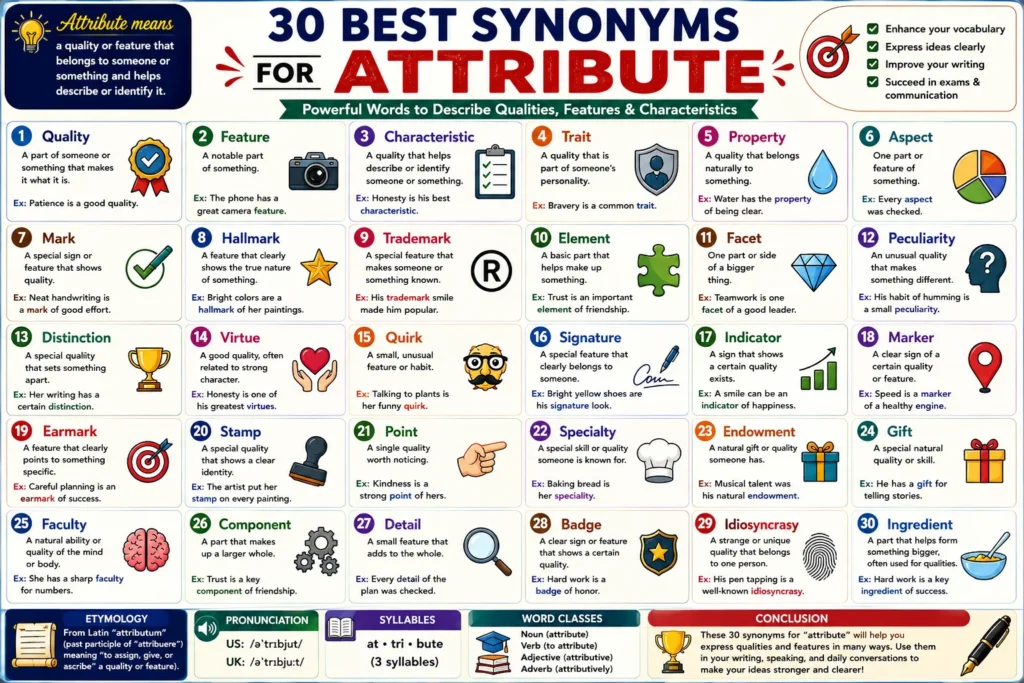
Attribute means a quality or feature that belongs to someone or something. Think about a superhero story. The hero has one special attribute: super strength. That one thing makes him different from everyone else. People use this word a lot to talk about what makes a person, thing, or idea special. Learning synonyms for attribute like this helps English learners and writers. It helps you say the same idea in fresh ways. Synonyms for attribute also makes your writing sound more clear. This article will teach you the meaning of attribute. You will learn its history, how to say it, and 30 words that mean the same thing.
Meaning of Attribute
Definition
Attribute (Noun): A quality or feature that belongs to a person, thing, or idea.
Examples
- Kindness is one of her best attributes.
- Speed is a key attribute of this car.
Connotative Meaning
- Positive tone: This word often feels good, like naming a strength or a special skill.
- Negative tone: This word can sound plain even when describing a weak or bad quality, such as “a negative attribute.”
- Neutral tone: In science or computer work, this word is often used in a plain, factual way, like listing details about a thing.
Etymology
- This word comes from Latin “attributum.”
- That word came from “attribuere,” meaning “to give” or “to assign.”
- The Latin word joined “ad-” (meaning “to”) and “tribuere” (meaning “to give”).
Short History
- Old English (450–1100): This word did not exist yet. People used simpler words to talk about a thing’s quality.
- Middle English (1100–1500): The word “attribute” came into English near the end of this time. It came from French, which took it from Latin.
- Modern English (1500–Present): The word became common in writing about people, art, and later in science and computers, to describe features or details.
Pronunciation (US & UK – IPA)
- US: /ˈætrɪˌbjuːt/
- UK: /ˈætrɪbjuːt/
Syllables
at-tri-bute (3 syllables)
Affixation Pattern of Attribute
- Root: tribute (from Latin “tribuere,” meaning “to give”)
- Prefix: at- (a form of “ad-,” meaning “to”)
- Suffix: none
Word Formation:
- Attribute (noun/verb)
- Attribution (naming word)
- Attributive (describing word)
- Attributable (describing word)
Discover related vocabulary https://synonymhubb.com/synonyms-for-accomplishment/
Synonyms of Attribute
1. Quality (Noun) — US: /ˈkwɑːləti/ | UK: /ˈkwɒləti/
Meaning: A part of someone or something that makes it what it is. Examples:
- Patience is a good quality to have.
- The fabric has a soft quality.
2. Feature (Noun) — US: /ˈfiːtʃər/ | UK: /ˈfiːtʃə/
Meaning: A notable part of something. Examples:
- The new phone has a great camera feature.
- Kindness is a strong feature of her personality.
3. Characteristic (Noun) — US: /ˌkærɪktəˈrɪstɪk/ | UK: /ˌkærəktəˈrɪstɪk/
Meaning: A quality that helps describe or identify someone or something. Examples:
- Honesty is his best characteristic.
- Bright colors are a characteristic of the bird.
4. Trait (Noun) — US: /treɪt/ | UK: /treɪt/
Meaning: A quality that is part of someone’s personality. Examples:
- Bravery is a common trait among firefighters.
- Curiosity is a helpful trait in students.
5. Property (Noun) — US: /ˈprɑːpərti/ | UK: /ˈprɒpəti/
Meaning: A quality that belongs naturally to something. Examples:
- Water has the property of being clear.
- Metal has a shiny property.
6. Aspect (Noun) — US: /ˈæspɛkt/ | UK: /ˈæspɛkt/
Meaning: One part or feature of something. Examples:
- Every aspect of the plan was checked.
- Color is one aspect of good design.
7. Mark (Noun) — US: /mɑːrk/ | UK: /mɑːk/
Meaning: A special sign or feature that shows quality. Examples:
- Neat handwriting is a mark of good effort.
- Kindness left its mark on everyone she met.
8. Hallmark (Noun) — US: /ˈhɔːlˌmɑːrk/ | UK: /ˈhɔːlmɑːk/
Meaning: A feature that clearly shows the true nature of something. Examples:
- Bright colors are a hallmark of her paintings.
- Fast service is a hallmark of the restaurant.
9. Trademark (Noun) — US: /ˈtreɪdˌmɑːrk/ | UK: /ˈtreɪdmɑːk/
Meaning: A special feature that makes someone or something known. Examples:
- His trademark smile made him popular.
- Bold humor is her comedy trademark.
10. Element (Noun) — US: /ˈɛləmənt/ | UK: /ˈɛlɪmənt/
Meaning: A basic part that helps make up something. Examples:
- Trust is an important element of friendship.
- Surprise is a fun element in the story.
11. Facet (Noun) — US: /ˈfæsɪt/ | UK: /ˈfæsɪt/
Meaning: One part or side of a bigger thing. Examples:
- Teamwork is one facet of a good leader.
- The report showed every facet of the plan.
12. Peculiarity (Noun) — US: /pɪˌkjuːliˈærəti/ | UK: /pɪˌkjuːliˈærəti/
Meaning: An unusual quality that makes something different. Examples:
- His habit of humming is a small peculiarity.
- The house has a strange peculiarity.
13. Distinction (Noun) — US: /dɪˈstɪŋkʃən/ | UK: /dɪˈstɪŋkʃən/
Meaning: A special quality that sets something apart. Examples:
- Her writing has a certain distinction.
- The award gave the school great distinction.
14. Virtue (Noun) — US: /ˈvɜːrtʃuː/ | UK: /ˈvɜːtʃuː/
Meaning: A good quality, often related to strong character. Examples:
- Honesty is one of his greatest virtues.
- Patience is a helpful virtue for teachers.
15. Quirk (Noun) — US: /kwɜːrk/ | UK: /kwɜːk/
Meaning: A small, unusual feature or habit. Examples:
- Talking to plants is her funny quirk.
- Everyone has a small quirk or two.
16. Signature (Noun) — US: /ˈsɪɡnətʃər/ | UK: /ˈsɪɡnətʃə/
Meaning: A special feature that clearly belongs to someone. Examples:
- Bright yellow shoes became his signature look.
- The dish is the chef’s signature recipe.
17. Indicator (Noun) — US: /ˈɪndɪˌkeɪtər/ | UK: /ˈɪndɪˌkeɪtə/
Meaning: A sign that shows a certain quality exists. Examples:
- A smile can be an indicator of happiness.
- Good grades are an indicator of hard work.
18. Marker (Noun) — US: /ˈmɑːrkər/ | UK: /ˈmɑːkə/
Meaning: A clear sign of a certain quality or feature. Examples:
- Speed is a marker of a healthy engine.
- Confidence is a marker of good practice.
19. Earmark (Noun) — US: /ˈɪrˌmɑːrk/ | UK: /ˈɪəmɑːk/
Meaning: A feature that clearly points to something specific. Examples:
- Careful planning is an earmark of success.
- Loud music is an earmark of the festival.
20. Stamp (Noun) — US: /stæmp/ | UK: /stæmp/
Meaning: A special quality that shows a clear identity. Examples:
- The artist put her stamp on every painting.
- The city has its own unique stamp.
21. Point (Noun) — US: /pɔɪnt/ | UK: /pɔɪnt/
Meaning: A single quality worth noticing. Examples:
- Kindness is a strong point of hers.
- Speed is the car’s best point.
22. Specialty (Noun) — US: /ˈspɛʃəlti/ | UK: /ˈspɛʃəlti/
Meaning: A special skill or quality someone is known for. Examples:
- Baking bread is her specialty.
- Fast learning is his specialty.
23. Endowment (Noun) — US: /ɪnˈdaʊmənt/ | UK: /ɪnˈdaʊmənt/
Meaning: A natural gift or quality someone has. Examples:
- Musical talent was his natural endowment.
- She has a rich endowment of patience.
24. Gift (Noun) — US: /ɡɪft/ | UK: /ɡɪft/
Meaning: A special natural quality or skill. Examples:
- Singing is her true gift.
- He has a gift for telling stories.
25. Faculty (Noun) — US: /ˈfækəlti/ | UK: /ˈfækəlti/
Meaning: A natural ability or quality of the mind or body. Examples:
- She has a sharp faculty for numbers.
- His faculty for memory amazed everyone.
26. Component (Noun) — US: /kəmˈpoʊnənt/ | UK: /kəmˈpəʊnənt/
Meaning: A part that makes up a larger whole. Examples:
- Trust is a key component of friendship.
- Speed is a major component of the game.
27. Detail (Noun) — US: /ˈdiːteɪl/ | UK: /ˈdiːteɪl/
Meaning: A small feature that adds to the whole. Examples:
- Every detail of the plan was checked.
- The dress had a lovely lace detail.
28. Badge (Noun) — US: /bædʒ/ | UK: /bædʒ/
Meaning: A clear sign or feature that shows a certain quality. Examples:
- Hard work is a badge of honor for her.
- Confidence became his badge of success.
29. Idiosyncrasy (Noun) — US: /ˌɪdiəˈsɪŋkrəsi/ | UK: /ˌɪdiəˈsɪŋkrəsi/
Meaning: A strange or unique quality that belongs to one person. Examples:
- His idiosyncrasy of tapping his pen is well known.
- Every writer has a small idiosyncrasy.
30. Ingredient (Noun) — US: /ɪnˈɡriːdiənt/ | UK: /ɪnˈɡriːdiənt/
Meaning: A part that helps form something bigger, often used for qualities too. Examples:
- Hard work is a key ingredient of success.
- Trust is an important ingredient in friendship.
Prototype Meaning
When people hear the word attribute, they think of a special quality that helps describe a person or thing. It could be a skill, a habit, or a part of someone’s character. This word helps show what makes someone or something stand out.
Prototype Categorization
- Personality qualities: trait, characteristic, virtue, idiosyncrasy, quirk
- Notable or special features: feature, hallmark, trademark, signature, badge
- Natural gifts and skills: gift, faculty, endowment, specialty
- Parts of a bigger whole: element, component, aspect, facet, detail, ingredient
- Signs that show a quality: indicator, marker, earmark, mark, stamp, point
- General describing words: quality, property, distinction, peculiarity
Antonyms of Attribute
- Flaw
- Weakness
- Defect
- Shortcoming
- Absence (of a quality)
Short Questions and Answers
- What does attribute mean?
- It means a quality or feature that belongs to a person, thing, or idea.
- When should attribute be used?
- Use it when describing a special quality, skill, or feature of someone or something.
- Is attribute positive or negative?
- It is usually neutral or positive. It can describe both good and less helpful qualities.
- How is it different from similar words?
- “Feature” often describes something visible or noticeable. “Attribute” can describe both visible things and inner qualities, like kindness or patience.
Conclusion
Synonyms for attribute synonyms helps you grow your word bank. It makes your writing and talking more clear and descriptive. Synonyms for attribute helps you use different words instead of the same one again and again. Synonyms for attribute also helps you feel more sure when you speak English. Try to learn one new word from this list each day. Small steps like this help you grow a lot over time.

I’m Zahid Abbas, an educator, researcher, and digital publishing strategist with a passion for linguistics, grammar, and clear communication. As a content creator and SEO specialist, I craft research-driven, reader-focused content that empowers learners and makes knowledge accessible worldwide.