Country means a land area with its own government and people. Think about a boy who just moved to a new town. He tells his new friend, “My country has tall mountains and wide rivers.” He feels proud when he talks about his home. People use synonyms for country often to talk about nations, travel, and home. Learning new words like this helps English learners speak and write with more variety. Synonyms for country also helps writers avoid using the same word again and again. This article explains the meaning of country, its history, and how to say it. It also shares 30 words that mean almost the same thing.
Meaning of Country
Definition
Country (Noun): A land area with its own government, borders, and people.
Examples
- She was born in a small country in Europe.
- His country is known for its old castles.
Connotative Meaning
- Positive tone: This word can feel warm and proud, especially when someone talks about home.
- Negative tone: This word rarely feels bad, though it can feel sad in stories about war or leaving home.
- Neutral tone: In maps, news, and reports, this word is used in a plain, factual way.
Etymology
- This word comes from the Old French word “contree.”
- That word came from the Latin word “contrata,” meaning “the land lying opposite” or “a region.”
- The Latin word came from “contra,” meaning “against” or “facing.”
Short History
- Old English (450–1100):
- This word did not exist yet. People used words like “land” or “þeod” to describe a nation.
- Middle English (1100–1500):
- The word “contree” entered English from French, meaning “a land or region.”
- Modern English (1500–Present):
- The spelling settled as “country.” Today, it is used for nations and also for rural land outside cities.
Explore related topics https://synonymhubb.com/synonyms-for-necessity/
Pronunciation (US & UK – IPA)
- US: /ˈkʌntri/
- UK: /ˈkʌntri/
Syllables
coun-try (2 syllables)
Affixation Pattern of Country
- Root: contr (from Latin “contra,” meaning “against” or “facing”)
- Prefix: none
- Suffix: -y (a common noun-forming ending)
Word Formation:
Country (noun), countryside (noun), countryman (noun), and countrywide (adjective) all come from this root word.
Synonyms for Country
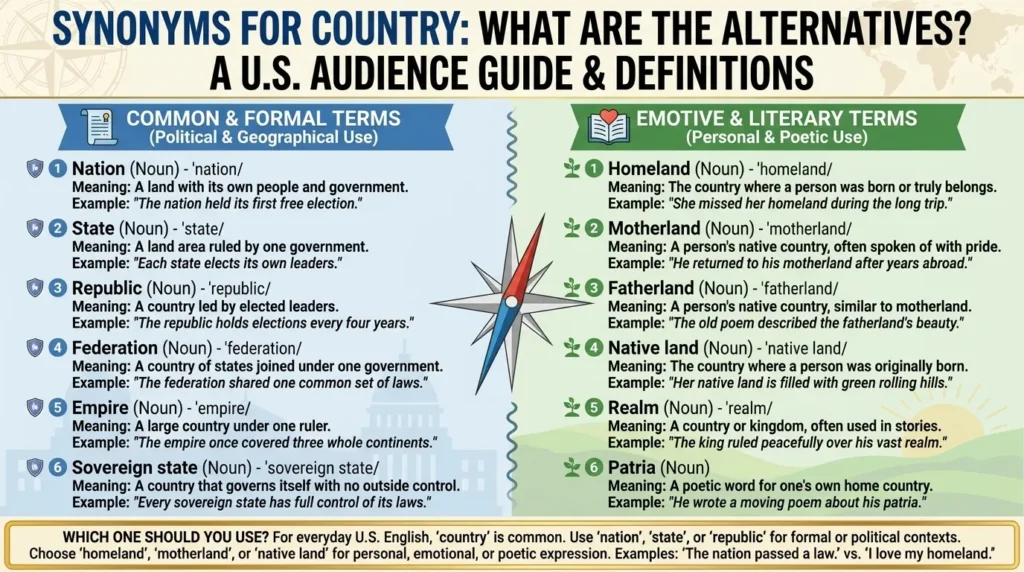
1. Nation (Noun) — US: /ˈneɪʃən/ | UK: /ˈneɪʃən/
Meaning: A land with its own people and government.
Examples:
- The nation held its first free election.
- Every nation has its own unique flag.
2. State (Noun) — US: /steɪt/ | UK: /steɪt/
Meaning: A land area ruled by one government.
Examples:
- The state passed a new law last year.
- Each state elects its own leaders.
3. Land (Noun) — US: /lænd/ | UK: /lænd/
Meaning: A place or area where people live and belong.
Examples:
- This land has been his home for many years.
- They sailed toward a completely new land.
4. Homeland (Noun) — US: /ˈhoʊmˌlænd/ | UK: /ˈhəʊmlænd/
Meaning: The country where a person was born or truly belongs.
Examples:
- She missed her homeland during the long trip.
- His homeland lies far across the ocean.
5. Motherland (Noun) — US: /ˈmʌðərˌlænd/ | UK: /ˈmʌðəlænd/
Meaning: A person’s native country, often spoken of with pride.
Examples:
- He returned to his motherland after years abroad.
- She sang proud songs about her motherland.
6. Fatherland (Noun) — US: /ˈfɑːðərˌlænd/ | UK: /ˈfɑːðəlænd/
Meaning: A person’s native country, similar to motherland.
Examples:
- He fought bravely to protect his fatherland.
- The old poem described the fatherland’s beauty.
7. Republic (Noun) — US: /rɪˈpʌblɪk/ | UK: /rɪˈpʌblɪk/
Meaning: A country led by elected leaders rather than a king.
Examples:
- The republic holds elections every four years.
- The new republic wrote its own set of laws.
8. Kingdom (Noun) — US: /ˈkɪŋdəm/ | UK: /ˈkɪŋdəm/
Meaning: A country ruled by a king or queen.
Examples:
- The kingdom had a long and rich history.
- The ancient kingdom was famous for its castles.
9. Territory (Noun) — US: /ˈtɛrəˌtɔːri/ | UK: /ˈtɛrətəri/
Meaning: A land area, often controlled by one government.
Examples:
- The territory was rich in natural resources.
- They explored the new territory with great care.
10. Realm (Noun) — US: /rɛlm/ | UK: /rɛlm/
Meaning: A country or kingdom, often used in stories.
Examples:
- The king ruled peacefully over his vast realm.
- The realm stretched across the whole green valley.
11. Domain (Noun) — US: /doʊˈmeɪn/ | UK: /dəʊˈmeɪn/
Meaning: An area of land under someone’s control or power.
Examples:
- The conquered land became part of his domain.
- The queen’s domain grew larger every single year.
12. Commonwealth (Noun) — US: /ˈkɑːmənˌwɛlθ/ | UK: /ˈkɒmənwɛlθ/
Meaning: A group of states or nations working together.
Examples:
- The commonwealth shared several important trade routes.
- Many small nations joined the growing commonwealth.
13. Dominion (Noun) — US: /dəˈmɪnjən/ | UK: /dəˈmɪnjən/
Meaning: A country or land under one ruling power.
Examples:
- The dominion expanded steadily under new leadership.
- The distant land became part of the dominion.
14. Nation-state (Noun) — US: /ˈneɪʃən steɪt/ | UK: /ˈneɪʃən steɪt/
Meaning: A country with one government and a shared people.
Examples:
- The new nation-state built strong, modern laws.
- Each nation-state manages its own daily affairs.
15. Sovereign state (Noun) — US: /ˈsɑːvərən steɪt/ | UK: /ˈsɒvrən steɪt/
Meaning: A country that governs itself with no outside control.
Examples:
- The island officially became a sovereign state.
- Every sovereign state has full control of its laws.
16. Native land (Noun) — US: /ˈneɪtɪv lænd/ | UK: /ˈneɪtɪv lænd/
Meaning: The country where a person was originally born.
Examples:
- He longed to see his native land again.
- Her native land is filled with green rolling hills.
17. Birthplace (Noun) — US: /ˈbɜːrθˌpleɪs/ | UK: /ˈbɜːθpleɪs/
Meaning: The country or place where someone was born.
Examples:
- Her birthplace is a small coastal fishing town.
- He proudly returned to his birthplace after many years.
18. Soil (Noun) — US: /sɔɪl/ | UK: /sɔɪl/
Meaning: A person’s home country, often spoken of with feeling.
Examples:
- He fought hard to protect his native soil.
- She missed the smell of her home soil deeply.
19. Region (Noun) — US: /ˈriːdʒən/ | UK: /ˈriːdʒən/
Meaning: A large area, sometimes used to mean a whole country.
Examples:
- The region follows its own unique traditions.
- Heavy rain fell steadily across the whole region.
20. Empire (Noun) — US: /ˈɛmpaɪər/ | UK: /ˈɛmpaɪə/
Meaning: A large country or group of lands under one ruler.
Examples:
- The empire once covered three whole continents.
- The old empire built many magnificent cities.
21. Principality (Noun) — US: /ˌprɪnsɪˈpæləti/ | UK: /ˌprɪnsɪˈpæləti/
Meaning: A small country ruled by a prince.
Examples:
- The tiny principality is known for its beauty.
- The young prince ruled the principality with great wisdom.
22. Union (Noun) — US: /ˈjuːnjən/ | UK: /ˈjuːnjən/
Meaning: A country formed by joining several states together.
Examples:
- The union grew stronger with each passing year.
- Every state joined the union of its own free will.
23. Federation (Noun) — US: /ˌfɛdəˈreɪʃən/ | UK: /ˌfɛdəˈreɪʃən/
Meaning: A country made of states joined under one shared government.
Examples:
- The federation shared one common set of laws.
- The new federation formed shortly after the long war.
24. Colony (Noun) — US: /ˈkɑːləni/ | UK: /ˈkɒləni/
Meaning: A land that is ruled by a distant country.
Examples:
- The colony eventually became its own independent nation.
- Early settlers built simple homes in the new colony.
25. Patria (Noun) — US: /ˈpɑːtriə/ | UK: /ˈpætriə/
Meaning: A poetic word for one’s own home country.
Examples:
- He wrote a moving poem about his patria.
- Her patria remained close to her heart always.
26. Native soil (Noun) — US: /ˈneɪtɪv sɔɪl/ | UK: /ˈneɪtɪv sɔɪl/
Meaning: One’s home country, described with deep, warm feeling.
Examples:
- He never once forgot his native soil.
- She often dreamed of returning to her native soil.
27. Mother country (Noun) — US: /ˈmʌðər ˈkʌntri/ | UK: /ˈmʌðə ˈkʌntri/
Meaning: A person’s home country, spoken of with love and pride.
Examples:
- He wrote letters home to his mother country.
- Her mother country shaped much of who she became.
28. Native country (Noun) — US: /ˈneɪtɪv ˈkʌntri/ | UK: /ˈneɪtɪv ˈkʌntri/
Meaning: The country where a person was born and raised.
Examples:
- He returned to his native country after finishing college.
- She often missed the food from her native country.
29. Home turf (Noun) — US: /hoʊm tɜːrf/ | UK: /həʊm tɜːf/
Meaning: A country or place that feels familiar and safe.
Examples:
- Playing on home turf gave the team extra confidence.
- She felt completely at ease back on her home turf.
30. Body politic (Noun) — US: /ˈbɑːdi ˈpɑːlɪtɪk/ | UK: /ˈbɒdi ˈpɒlɪtɪk/
Meaning: A formal term for a nation and all its people together.
Examples:
- The new law affected the entire body politic.
- Wise leaders always think of the body politic first.
Prototype Meaning
When people hear the word country, they picture a land with its own flag, people, and government. It brings to mind feelings of home, pride, and shared history. The word often connects closely to a sense of belonging.
Prototype Categorization
- Simple everyday words: nation, state, land, region
- Home-related words: homeland, motherland, fatherland, native land, native soil, native country, mother country, birthplace, home turf, patria, soil
- Ruled by one leader: kingdom, empire, principality, dominion, realm, domain
- Formed by joining parts: union, federation, commonwealth, nation-state
- Formal or political words: republic, sovereign state, colony, body politic
Antonyms of Country
- city
- town
- foreign land
- abroad
- colony (in the sense of not self-ruled)
Short Questions and Answers
- What does country mean?
- It means a land area with its own government, borders, and people.
- When should country be used?
- Use it when talking about a nation, its people, or a person’s home land.
- Is country positive or negative?
- It is usually neutral or positive, often feeling warm when tied to home and pride.
- How is it different from similar words?
- “Nation” often points mainly to the people and government. “Country” also includes the land itself, its borders, and its geography.
Conclusion
Synonyms for country helps you build a stronger, more expressive vocabulary. It makes your writing feel clearer and more meaningful, especially when describing home and belonging. Synonyms for country also helps you avoid repeating the same word again and again. It keeps your writing more interesting. Most importantly, learning new synonyms for country builds your confidence as an English speaker and writer. Try learning one new synonyms for country from this list each day, and watch your vocabulary grow steadily over time.

I’m Zahid Abbas, an educator, researcher, and digital publishing strategist with a passion for linguistics, grammar, and clear communication. As a content creator and SEO specialist, I craft research-driven, reader-focused content that empowers learners and makes knowledge accessible worldwide.