Imagine taking a shiny bicycle out of its box on your birthday morning. The paint sparkles in the sun, the tires are spotless, and it has never been ridden before. That clean bicycle is completely new. Something is new when it has recently been made, built, bought, or discovered for the first time. People use synonyms for newevery day because life constantly brings fresh starts, recent ideas, and unfamiliar places.
Learning synonyms for new is very important for English learners and content writers. Using different synonyms for new keeps your writing exciting and prevents repeating the same basic term. This article discusses the meaning of new. Also 30 useful synonyms for new with simple definitions, natural example sentences, emotional tones, word history, clear pronunciations, and helpful categories written in easy, smooth sentences.
Meaning of New
Definition
New (Adjective): Made, built, bought, or discovered recently, or seen for the first time.
Examples
- She wore a new dress to the family party.
- They moved into a new house near the park.
Connotative Meaning
- Positive tone: Brings feelings of fresh hope, excitement, modern ideas, and clean starts.
- Negative tone: Can suggest a lack of experience, raw skill, or losing familiar comfort.
- Neutral tone: Acts as a simple label for recent time, current order, or latest versions.
Etymology
- Source: The word new comes from the Proto-Germanic *neuja- and is related to the Latin novus. Both refer to something recent or fresh.
- Old English (450–1100):
- It appeared as nīwe or neowe and was used for recent things or young animals.
- Middle English (1100–1500):
- The spelling changed to newe, while the main idea of freshness remained.
- Modern English (1500–Present):
- The spelling became new, and it is now a common adjective for fresh creations and recent events.
Pronunciation
- US: /nuː/
- UK: /njuː/
Syllables
new
Affixation Pattern
- Root: New
- Prefix: None
- Suffix: None
Word Formation:
- New (Adjective / Adverb)
- Newness (Noun)
- Newly (Adverb)
- Renew (Verb)
- Renewal (Noun)
- Renewable (Adjective)
Explore related topics https://synonymhubb.com/synonyms-for-high-quality/
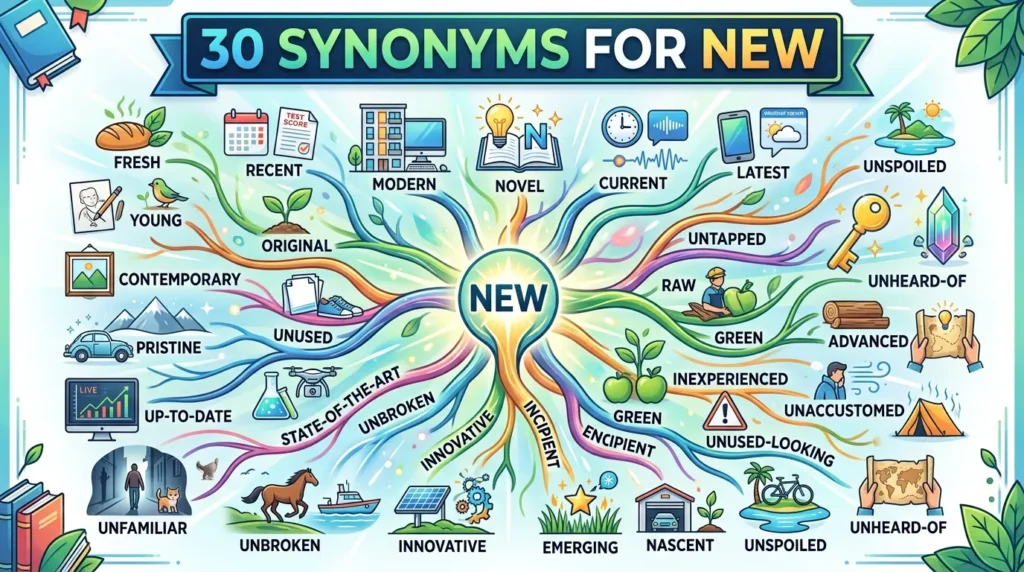
30 Synonyms for New
1. Fresh (Adjective) — US: /frɛʃ/ | UK: /frɛʃ/
Meaning: Recently made, gathered, or arrived without losing good quality.
- Example 1: We bought fresh bread from the neighborhood bakery.
- Example 2: She started the morning with a fresh idea.
2. Recent (Adjective) — US: /ˈriː.sənt/ | UK: /ˈriː.sənt/
Meaning: Happened or created a short time ago.
- Example 1: He shared his recent test scores with his parents.
- Example 2: The news covered the recent rain storm.
3. Modern (Adjective) — US: /ˈmɑː.dɚn/ | UK: /ˈmɒd.ən/
Meaning: Designed or built using current ideas and styles.
- Example 1: They live in a modern apartment near downtown.
- Example 2: Computers are vital tools in modern schools.
4. Novel (Adjective) — US: /ˈnɑː.vəl/ | UK: /ˈnɒv.əl/
Meaning: Strikingly original or unusual in a clever way.
- Example 1: She solved the puzzle using a novel method.
- Example 2: The inventor presented a novel device today.
5. Current (Adjective) — US: /ˈkɝː.ənt/ | UK: /ˈkʌr.ənt/
Meaning: Happening, belonging, or existing at the present time.
- Example 1: Please write down your current home address.
- Example 2: What is your current favorite song?
6. Latest (Adjective) — US: /ˈleɪ.t̬ɪst/ | UK: /ˈleɪ.tɪst/
Meaning: The most recent or most modern version of something.
- Example 1: She bought the latest book by her favorite writer.
- Example 2: Here is the latest report from the weather station.
7. Young (Adjective) — US: /jʌŋ/ | UK: /jʌŋ/
Meaning: In an early period of growth or life.
- Example 1: A young bird sat near the green tree.
- Example 2: The young plant grew three inches this week.
8. Original (Adjective) — US: /əˈrɪdʒ.ən.əl/ | UK: /əˈrɪdʒ.ən.əl/
Meaning: Created first and not copied from anything else.
- Example 1: He showed us his original drawing of a dragon.
- Example 2: The artist kept the original plan simple.
9. Contemporary (Adjective) — US: /kənˈtɛm.pə.rɛr.i/ | UK: /kənˈtɛm.pər.ər.i/
Meaning: Belonging to the same time period or present day.
- Example 1: The museum displays contemporary art paintings.
- Example 2: We studied contemporary history in our class.
10. Unused (Adjective) — US: /ʌnˈjuːzd/ | UK: /ʌnˈjuːzd/
Meaning: Not put into work or never used before.
- Example 1: He opened a pack of unused paper sheets.
- Example 2: The new shoes remained unused in the box.
11. Pristine (Adjective) — US: /ˈprɪs.tiːn/ | UK: /ˈprɪs.tiːn/
Meaning: Completely clean, untouched, and in perfect order.
- Example 1: Snow covered the meadow in a pristine blanket.
- Example 2: The old car was kept in pristine condition.
12. Unfamiliar (Adjective) — US: /ˌʌn.fəˈmɪl.i.ɚ/ | UK: /ˌʌn.fəˈmɪl.i.ər/
Meaning: Not known, seen, or experienced in the past.
- Example 1: They walked down an unfamiliar street in town.
- Example 2: The loud sound was unfamiliar to the kitten.
13. Untried (Adjective) — US: /ʌnˈtraɪd/ | UK: /ʌnˈtraɪd/
Meaning: Not tested or used in real life yet.
- Example 1: The coach used an untried strategy in the game.
- Example 2: It is risky to test an untried boat in deep water.
14. Unbroken (Adjective) — US: /ʌnˈbroʊ.kən/ | UK: /ʌnˈbrəʊ.kən/
Meaning: Not damaged, trained, or altered by use.
- Example 1: They rode across unbroken land during the trip.
- Example 2: The horse was still wild and unbroken.
15. Innovative (Adjective) — US: /ˈɪn.ə.veɪ.t̬ɪv/ | UK: /ˈɪn.ə.və.tɪv/
Meaning: Using clever new ideas and creative methods.
- Example 1: The company built an innovative solar toy.
- Example 2: Her innovative thinking solved the team problem.
16. State-of-the-art (Adjective) — US: /ˌsteɪt.əv.ðiːˈɑːrt/ | UK: /ˌsteɪt.əv.ðiːˈɑːt/
Meaning: Built with the best and most recent technology.
- Example 1: The hospital opened a state-of-the-art lab today.
- Example 2: Students practiced inside a state-of-the-art room.
17. Cutting-edge (Adjective) — US: /ˌkʌt̬.ɪŋˈɛdʒ/ | UK: /ˌkʌt.ɪŋˈɛdʒ/
Meaning: At the very newest and most advanced stage of growth.
- Example 1: Scientists carry out cutting-edge research here.
- Example 2: The store sells cutting-edge computer gear.
18. Up-to-date (Adjective) — US: /ˌʌp.təˈdeɪt/ | UK: /ˌʌp.təˈdeɪt/
Meaning: Including the newest information and modern facts.
- Example 1: Keep your safety map up-to-date on trips.
- Example 2: This chart shows up-to-date sales records.
19. Untapped (Adjective) — US: /ʌnˈtæpt/ | UK: /ʌnˈtæpt/
Meaning: Available but not used or drawn upon yet.
- Example 1: The young worker showed untapped skill.
- Example 2: They found an untapped well of fresh water.
20. Advanced (Adjective) — US: /ədˈvænst/ | UK: /ədˈvɑːnst/
Meaning: Far ahead in modern development or skill.
- Example 1: This phone features an advanced camera sensor.
- Example 2: She reads advanced story books in class.
21. Raw (Adjective) — US: /rɑː/ | UK: /rɔː/
Meaning: In an early natural state or lacking practice.
- Example 1: The team noticed his raw talent on the field.
- Example 2: We used raw wood to build the garden bench.
22. Green (Adjective) — US: /ɡriːn/ | UK: /ɡriːn/
Meaning: Young, lacking experience, or newly grown.
- Example 1: The green worker learned the job rules fast.
- Example 2: They picked green apples off the branch.
23. Inexperienced (Adjective) — US: /ˌɪn.ɪkˈspɪr.i.ənst/ | UK: /ˌɪn.ɪkˈspɪə.ri.ənst/
Meaning: Having little or no knowledge gained from practice.
- Example 1: An inexperienced driver should go slowly.
- Example 2: The inexperienced cook followed the recipe card.
24. Unaccustomed (Adjective) — US: /ˌʌn.əˈkʌs.təmd/ | UK: /ˌʌn.əˈkʌs.təmd/
Meaning: Not familiar with or used to a situation.
- Example 1: She was unaccustomed to the cold winter wind.
- Example 2: He felt unaccustomed to sleeping in a tent.
25. Incipient (Adjective) — US: /ɪnˈsɪp.i.ənt/ | UK: /ɪnˈsɪp.i.ənt/
Meaning: Just beginning to develop or appear.
- Example 1: The doctor caught the incipient cold early.
- Example 2: We saw an incipient fire in the dry grass.
26. Emerging (Adjective) — US: /ɪˈmɝː.dʒɪŋ/ | UK: /ɪˈmɜː.dʒɪŋ/
Meaning: Starting to exist, grow, or become known.
- Example 1: She is an emerging star in local sports.
- Example 2: We studied emerging trends in web design.
27. Nascent (Adjective) — US: /ˈnæs.ənt/ | UK: /ˈnæs.ənt/
Meaning: Coming into existence and showing future growth.
- Example 1: Their nascent business started in a garage.
- Example 2: He nurtured his nascent love for music.
28. Unused-looking (Adjective) — US: /ʌnˈjuːzd-ˌlʊk.ɪŋ/ | UK: /ʌnˈjuːzd-ˌlʊk.ɪŋ/
Meaning: Appearing fresh and clean as if never handled.
- Example 1: She found an unused-looking book on the shelf.
- Example 2: The vintage bike had an unused-looking seat.
29. Unspoiled (Adjective) — US: /ʌnˈspɔɪld/ | UK: /ʌnˈspɔɪld/
Meaning: Remaining in a natural, clean, undamaged state.
- Example 1: We visited an unspoiled island on vacation.
- Example 2: The lake water remained clear and unspoiled.
30. Unheard-of (Adjective) — US: /ʌnˈhɝːd.ɑːv/ | UK: /ʌnˈhɜːd.ɒv/
Meaning: Completely new or not known about before.
- Example 1: Winning three awards was unheard-of for a beginner.
- Example 2: They discovered an unheard-of plant in the woods.
Prototype Meaning
The typical meaning of new is something recently made, bought, or seen for the first time. When people hear this word, they often think of a clean, unused item or a fresh start with no old wear or history.
Prototype Categorization
- Fresh & Clean Conditions: Fresh, pristine, unused, unbroken, unspoiled, unused-looking. Use these words when highlighting that an item is completely clean or untouched.
- Modern & Advanced Creations: Modern, latest, state-of-the-art, cutting-edge, advanced, innovative, up-to-date. Best when describing technology, inventions, or current styles.
- First-Time & Original Ideas: Original, novel, nascent, incipient, emerging, unheard-of, untapped. Perfect for unique ideas, starting projects, or things discovered for the first time.
- Inexperienced & Early Stages: Young, raw, green, inexperienced, unfamiliar, untried, unaccustomed. Great for describing beginners, untried plans, or early growth stages.
Antonyms of New
- Old
- Ancient
- Used
- Worn
- Stale
- Familiar
Short Questions and Answers
- What does new mean?
- It means made, bought, built, or seen recently for the first time.
- When should new be used?
- Use it when describing fresh objects, recent events, modern tools, or unfamiliar ideas.
- Is new positive or negative?
- It is mostly positive or neutral, standing for clean starts, growth, and modern progress.
- How is it different from similar words?
- New refers to recent origin, while fresh emphasizes pure condition, and modern describes current style.
Conclusion
Synonyms for new helps you describe fresh ideas, or early beginnings with precision. Building a rich vocabulary improves your writing. Strengthens your speaking skills, and prevents boring word repetition. Knowing different synonyms for new gives you confidence to choose the perfect term for any story or essay. Make it a fun daily habit to practice these new synonyms for new in your conversations. English learners and content writers can improve their vocabulary, writing, and speaking skills by learning synonyms for new.

I’m Zahid Abbas, an educator, researcher, and digital publishing strategist with a passion for linguistics, grammar, and clear communication. As a content creator and SEO specialist, I craft research-driven, reader-focused content that empowers learners and makes knowledge accessible worldwide.