Imagine walking into a quiet room filled with wooden shelves that reach up to the high ceiling. Thousands of colorful books line the walls, and the fresh smell of paper fills the air as children sit quietly at low tables to read their favorite stories. That wonderful place is a library. A library is a place or collection where books, media, and information are stored for people to read or borrow. People use synonyms for library often because reading and finding facts are essential parts of daily school and community life.
Learning synonyms for library is very important for English learners and content writers who want to grow their vocabulary. Using different synonyms for library makes your writing interesting and stops you from repeating the same term. This article discusses the meaning of library. Along with 30 synonyms for library by giving easy definitions, clear examples, grammar points, word history, pronunciations. And also useful word groups written in simple, flowing sentences.
Meaning of Library
Definition
Library (Noun):
A building, room, or digital collection where books, records, and information are kept for reading, study, or borrowing.
Examples
- She goes to the local library every Saturday to borrow new storybooks.
- Our school library has thousands of helpful science books and quiet tables.
Connotative Meaning
- Positive tone: It often suggests peaceful learning, discovery, quiet study, and shared knowledge.
- Negative tone: In some contexts, it may suggest strict rules, too much silence, or an old and dusty place.
- Neutral tone: Acts as a simple label for a building, book room, or digital computer folder.
Etymology
- Source: The word “library” comes from the Latin librarium, meaning a place for books. It comes from liber, meaning “book” or “the inner bark of a tree.”
- Old English (450–1100):
- English speakers used words like bōchūs, meaning “book-house,” because the word “library” was not used in English yet.
- Middle English (1100–1500):
- The word “library” came into English as librarie through Anglo-French. It meant a room or building where books were kept.
- Modern English (1500–Present):
- The meaning of “library” grew to include public places for learning. Also personal collections of books, and digital collections such as software libraries.
Pronunciation
Syllables
li-brar-y
Affixation Pattern
- Root: Libr (from Latin liber, meaning book)
- Prefix: None
- Suffix: -ary (meaning a place belonging to or connected with)
Word Formation:
- Library (Noun)
- Librarian (Noun)
- Librarianship (Noun)
- Interlibrary (Adjective)
Explore related topics https://synonymhubb.com/synonyms-for-method/
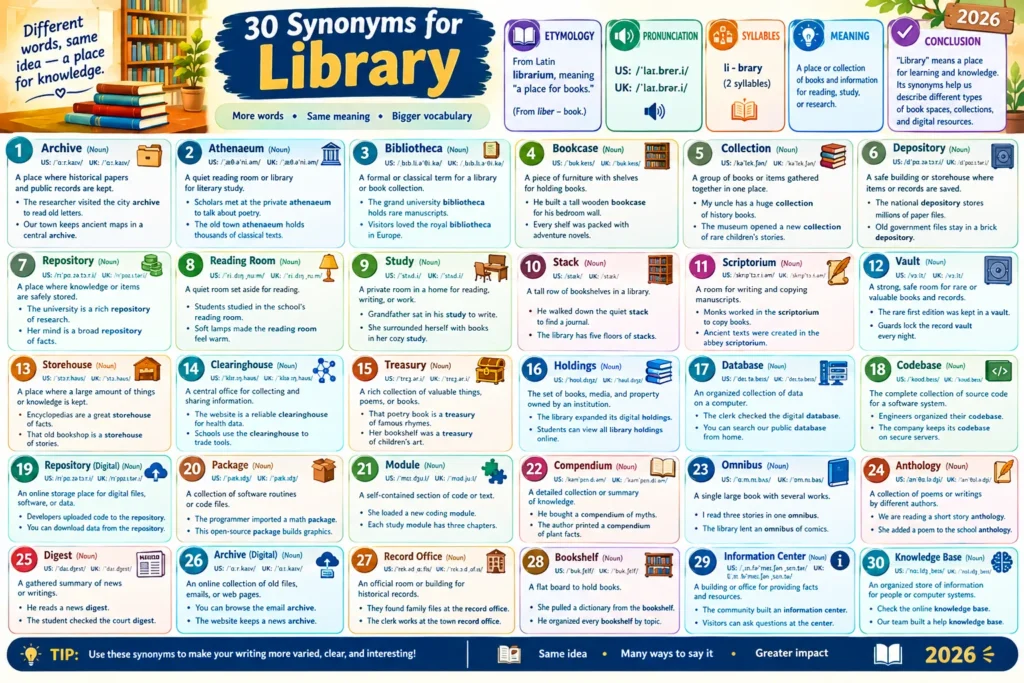
30 Synonyms for Library
1. Archive (Noun) — US: /ˈɑːr.kaɪv/ | UK: /ˈɑː.kaɪv/
Meaning: A place where historical papers and public records are kept.
- Example 1: The researcher visited the city archive to read old letters.
- Example 2: Our town keeps ancient maps safe in a central archive.
2. Athenaeum (Noun) — US: /ˌæθ.əˈniː.əm/ | UK: /ˌæθ.əˈniː.əm/
Meaning: A quiet reading room or library for literary study.
- Example 1: Scholars met at the private athenaeum to talk about poetry.
- Example 2: The old town athenaeum holds thousands of classical texts.
3. Bibliotheca (Noun) — US: /ˌbɪb.li.əˈθiː.kə/ | UK: /ˌbɪb.lɪ.əˈθiː.kə/
Meaning: A formal or classical term for a library or book collection.
- Example 1: The grand university bibliotheca holds rare old manuscripts.
- Example 2: Visitors loved seeing the royal bibliotheca in Europe.
4. Bookcase (Noun) — US: /ˈbʊk.keɪs/ | UK: /ˈbʊk.keɪs/
Meaning: A piece of furniture with shelves used for holding books.
- Example 1: He built a tall wooden bookcase for his bedroom wall.
- Example 2: Every shelf on the bookcase was packed with adventure novels.
5. Collection (Noun) — US: /kəˈlɛk.ʃən/ | UK: /kəˈlɛk.ʃən/
Meaning: A group of books or items gathered together in one place.
- Example 1: My uncle has a huge collection of historic history books.
- Example 2: The museum opened a new collection of rare children’s stories.
6. Depository (Noun) — US: /dɪˈpɑː.zə.tɔːr.i/ | UK: /dɪˈpɒz.ɪ.tər.i/
Meaning: A safe building or storehouse where items or records are saved.
- Example 1: The national depository stores millions of official paper files.
- Example 2: Old government files stay protected inside a brick depository.
7. Repository (Noun) — US: /rɪˈpɑː.zə.tɔːr.i/ | UK: /rɪˈpɒz.ɪ.tər.i/
Meaning: A place where large amounts of knowledge or items are safely stored.
- Example 1: The university serves as a rich repository of scientific research.
- Example 2: Her mind is a broad repository of helpful historical facts.
8. Reading Room (Noun) — US: /ˈriː.dɪŋ ˌruːm/ | UK: /ˈriː.dɪŋ ˌruːm/
Meaning: A quiet room set aside specifically for people to sit and read.
- Example 1: Students studied silently in the school’s sunny reading room.
- Example 2: Soft lamps made the neighborhood reading room feel very warm.
9. Study (Noun) — US: /ˈstʌd.i/ | UK: /ˈstʌd.i/
Meaning: A private room in a home used for reading, writing, or work.
- Example 1: Grandfather sat in his peaceful study to finish writing his novel.
- Example 2: She surrounded herself with books in her cozy home study.
10. Stack (Noun) — US: /stæk/ | UK: /stæk/
Meaning: A tall row of bookshelves loaded with books in a library.
- Example 1: He walked down the quiet stack to find an old history journal.
- Example 2: The university library has five floors of deep book stacks.
11. Scriptorium (Noun) — US: /skrɪpˈtɔːr.i.əm/ | UK: /skrɪpˈtɔː.ri.əm/
Meaning: A room set aside for writing and copying manuscripts.
- Example 1: Monks worked slowly inside the stone scriptorium to copy books.
- Example 2: Ancient handwritten texts were created in the abbey scriptorium.
12. Vault (Noun) — US: /vɔːlt/ | UK: /vɔːlt/
Meaning: A strong, safe room used to guard rare or valuable books and records.
- Example 1: The rare first edition was kept inside a temperature-controlled vault.
- Example 2: Security guards lock the record vault every night.
13. Storehouse (Noun) — US: /ˈstɔːr.haʊs/ | UK: /ˈstɔː.haʊs/
Meaning: A place where a large amount of things or knowledge is kept.
- Example 1: The encyclopedias act as a great storehouse of useful facts.
- Example 2: That old bookshop is a true storehouse of forgotten stories.
14. Clearinghouse (Noun) — US: /ˈklɪr.ɪŋ.haʊs/ | UK: /ˈklɪə.rɪŋ.haʊs/
Meaning: A central agency or office for collecting and giving out information.
- Example 1: The medical website acts as a reliable clearinghouse for health data.
- Example 2: Schools use that main clearinghouse to trade teaching tools.
15. Treasury (Noun) — US: /ˈtrɛʒ.ɚ.i/ | UK: /ˈtrɛʒ.ər.i/
Meaning: A rich collection of valuable things, poems, or books.
- Example 1: That poetry book is a wonderful treasury of famous rhymes.
- Example 2: Her home bookshelf was a priceless treasury of children’s art.
16. Holdings (Noun) — US: /ˈhoʊl.dɪŋz/ | UK: /ˈhəʊl.dɪŋz/
Meaning: The whole set of books, media, and property owned by a institution.
- Example 1: The city library expanded its digital holdings this year.
- Example 2: Students can search the online database to view all library holdings.
17. Database (Noun) — US: /ˈdeɪ.t̬ə.beɪs/ | UK: /ˈdeɪ.tə.beɪs/
Meaning: An organized collection of structured data stored on a computer.
- Example 1: The clerk checked the digital database to see if the book was in.
- Example 2: You can search our public database from your home computer.
18. Codebase (Noun) — US: /ˈkoʊd.beɪs/ | UK: /ˈkəʊd.beɪs/
Meaning: The complete collection of source code used to build a software system.
- Example 1: Software engineers organized their file codebase to fix errors.
- Example 2: The company keeps its entire program codebase on secure servers.
19. Repository (Digital) (Noun) — US: /rɪˈpɑː.zə.tɔːr.i/ | UK: /rɪˈpɒz.ɪ.tər.i/
Meaning: An online storage place for digital files, software, or data.
- Example 1: Developers uploaded their new software code to the public repository.
- Example 2: You can download free data files from the digital research repository.
20. Package (Noun) — US: /ˈpæk.ɪdʒ/ | UK: /ˈpæk.ɪdʒ/
Meaning: A collection of software routines or code files bundled together.
- Example 1: The programmer imported a math package to solve the hard equation.
- Example 2: This open-source package helps web designers build graphics fast.
21. Module (Noun) — US: /ˈmɑː.dʒuːl/ | UK: /ˈmɒd.juːl/
Meaning: A self-contained section of code or text that works with a larger system.
- Example 1: She loaded a new coding module into her computer program.
- Example 2: Each study module contains three chapters and short quizzes.
22. Compendium (Noun) — US: /kəmˈpɛn.di.əm/ | UK: /kəmˈpɛn.di.əm/
Meaning: A detailed collection or summary of knowledge on one subject.
- Example 1: He bought a thick compendium of ancient world myths.
- Example 2: The author printed a quick compendium of plant science facts.
23. Omnibus (Noun) — US: /ˈɑːm.nɪ.bʌs/ | UK: /ˈɒm.nɪ.bəs/
Meaning: A single large book containing several works previously printed alone.
- Example 1: I read three mystery stories in one thick fantasy omnibus.
- Example 2: The library lent out an omnibus of famous comic strips.
24. Anthology (Noun) — US: /ænˈθɑː.lə.dʒi/ | UK: /ænˈθɒl.ə.dʒi/
Meaning: A published collection of poems, short stories, or writings by various authors.
- Example 1: Our English class is reading a modern short story anthology.
- Example 2: She contributed a short poem to the annual school anthology.
25. Digest (Noun) — US: /ˈdaɪ.dʒɛst/ | UK: /ˈdaɪ.dʒɛst/
Meaning: A gathered summary or collection of shortened news or literary pieces.
- Example 1: He reads a monthly news digest to keep up with world events.
- Example 2: The law student checked the court digest for past legal decisions.
26. Archive (Digital) (Noun) — US: /ˈɑːr.kaɪv/ | UK: /ˈɑː.kaɪv/
Meaning: An online collection of old computer files, emails, or web pages.
- Example 1: You can browse through our email archive to find last month’s notes.
- Example 2: The website keeps a digital news archive dating back to 2005.
27. Record Office (Noun) — US: /ˈrɛk.ɚd ˌɑː.fɪs/ | UK: /ˈrɛk.ɔːd ˌɒf.ɪs/
Meaning: An official room or building where public historical records are stored.
- Example 1: They found their family tree files at the county record office.
- Example 2: The clerk works daily at the town record office filing land deeds.
28. Bookshelf (Noun) — US: /ˈbʊk.ʃɛlf/ | UK: /ˈbʊk.ʃɛlf/
Meaning: A flat board mounted on a wall or inside a cabinet to hold books.
- Example 1: She reached up to pull a heavy dictionary off the top bookshelf.
- Example 2: He organized every single bookshelf by topic and author name.
29. Information Center (Noun) — US: /ˌɪn.fɚˈmeɪ.ʃən ˌsɛn.t̬ɚ/ | UK: /ˌɪn.fəˈmeɪ.ʃən ˌsɛn.tə/
Meaning: A building or office dedicated to providing facts and resources to people.
- Example 1: The community built a modern information center in the park.
- Example 2: Visitors can ask questions at the campus information center.
30. Knowledge Base (Noun) — US: /ˈnɑː.lɪdʒ ˌbeɪs/ | UK: /ˈnɒl.ɪdʒ ˌbeɪs/
Meaning: An organized store of information used by people or computer systems.
- Example 1: Check the online support knowledge base to solve laptop issues.
- Example 2: Our customer service team built a useful help knowledge base.
Prototype Meaning
The main job of library is to describe a dedicated space or organized collection created for storing books and information. When people hear this word, they picture a quiet brick building filled with wooden shelves, reading tables, friendly librarians, and thousands of books ready for borrowing.
Prototype Categorization
- Physical Buildings & Study Rooms:
- Athenaeum, reading room, study, scriptorium, record office, information center. Use these terms when describing real physical spaces where people sit to study or read books.
- Storage & Historic Collections:
- Archive, depository, repository, vault, storehouse, stack, holdings, collection. Best when emphasizing the physical or historical preservation of papers, books, and records.
- Book Containers & Print Volumes:
- Bookcase, bookshelf, compendium, omnibus, anthology, digest, treasury. Great for describing furniture or single large books containing multiple collected stories.
- Digital & Software Systems:
- Database, codebase, repository (digital), package, module, archive (digital), clearinghouse, knowledge base. Perfect for modern tech contexts like programming libraries or online data storage.
Antonyms of Library
- Disorganization
- Book shortage
- Empty space
- Scatter
- Information black hole
- Content void
Short Questions and Answers
- What does library mean?
- It means a place, room, or collection where books, media, and records are kept for study or borrowing.
- When should library be used?
- Use: Use “library” when talking about a public place where people can read or borrow books, a personal collection of books, or an organized collection of digital files.
- Is “library” positive or negative?
- “Library” is usually positive or neutral. It is linked with learning, knowledge, study, and community.
- How is it different from similar words?
- A library provides books and other resources for people to read or borrow. A bookstore sells books, while an archive keeps important or historical records for long-term use.
Conclusion
Synonyms for library helps you talk about learning spaces, collections, and tech tools with total ease. Building a larger vocabulary makes your writing better. Improves your speaking skills, and stops you from using the same words again and again. Choosing different terms gives you confidence to express your ideas clearly in conversations. Try using a few of these new synonyms for library in your writing. English learners and content writers can improve their vocabulary, writing, and speaking skills by learning synonyms for library.

I’m Zahid Abbas, an educator, researcher, and digital publishing strategist with a passion for linguistics, grammar, and clear communication. As a content creator and SEO specialist, I craft research-driven, reader-focused content that empowers learners and makes knowledge accessible worldwide.