Relax means to rest, feel calm, or become less tense. Imagine coming home after a long day at work. You sit on the sofa, take a deep breath, and listen to soft music. You begin to relax. Your body feels less tired, and your mind feels calm.
The word relax is common in daily speech, books, emails, and conversations. We use it when we talk about rest, stress, free time, and comfort. Learning synonyms of relax helps English learners express feelings in more ways. It also helps writers avoid repeating the same word in every paragraph.
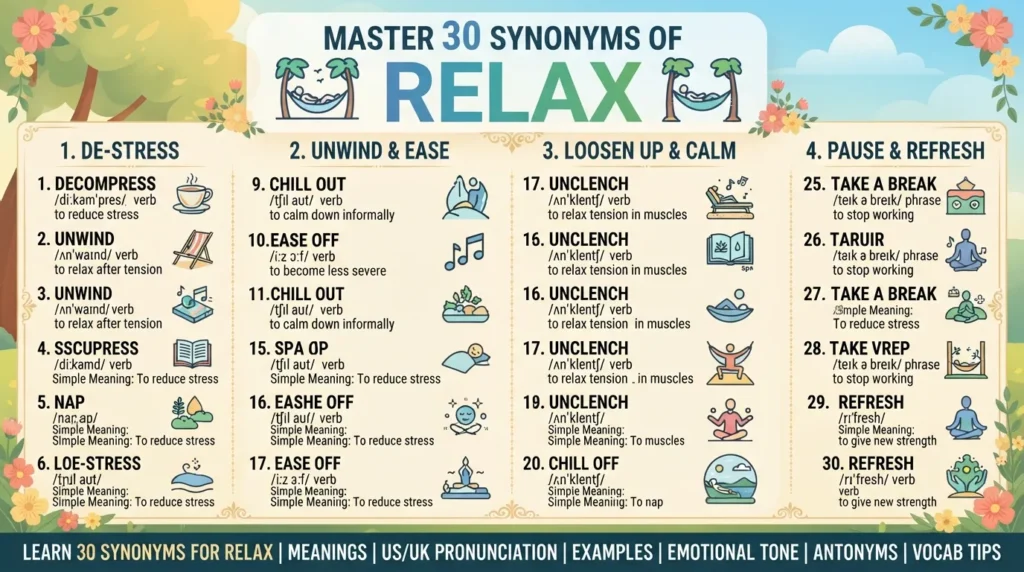
Some synonyms focus on resting the body. Others describe calming the mind, easing stress, or taking a break. In this guide, you will learn the meaning, pronunciation, history, and grammar of relax. You will also discover 30 related words, with simple meanings and examples, so you can choose the best word for each situation.
Meaning of Relax
Relax (verb): To rest, become calm, or make something less tight, tense, or strict.
Examples
- I like to relax with a book after work.
- Take a deep breath and relax before the test.
Relax can also mean to make a rule less strict or to loosen something.
- The school may relax its dress code.
- Relax your shoulders and sit comfortably.
Connotative Meaning
- Positive tone: Relax often suggests peace, comfort, rest, and freedom from stress.
- Negative tone: In some situations, it can suggest that someone is not taking a problem seriously enough.
- Neutral tone: It can simply describe becoming less tense or making something less strict.
Examples:
- Positive: A warm bath helps me relax.
- Negative: Do not relax your efforts before the work is done.
- Neutral: The muscles relax after exercise.
Etymology of Relax
- Source language: Latin, through French.
- Latin root: Relaxare, meaning “to loosen” or “to open up.”
- Word parts: The Latin elements re- and laxare contributed to the idea of loosening or easing.
- Core meaning: The word developed from the idea of loosening something to also mean easing tension, resting, or becoming calm.
A Short History
- Old English (450–1100): Relax was not a common established English word in this period. English used other words to express rest and ease.
- Middle English (1100–1500): The word entered English through French and Latin influences. It was used in the sense of loosening or easing.
- Modern English (1500–present): Relax gained wider use. It came to describe resting, reducing stress, loosening muscles, and making rules less strict.
Pronunciation of Relax
- US: /rɪˈlæks/
- UK: /rɪˈlæks/
The main stress falls on the second syllable.
Syllables
re-lax — 2 syllables
Affixation Pattern of Relax
- Root: lax — linked to the idea of being loose or not tight.
- Prefix: re- — part of the word’s Latin history; it should not be treated as a simple modern prefix meaning “again” in every use of relax.
- Suffix: None in the base verb relax.
- Word formation: Relax is a verb. Common related forms include relaxed (adjective or past form), relaxing (adjective or verb form), relaxation (noun), and relaxingly (adverb, rare).
Common Word Forms
- Relax (verb): I relax after dinner.
- Relaxes (verb): She relaxes by reading.
- Relaxed (adjective): He felt relaxed after the walk.
- Relaxing (adjective): The music is relaxing.
- Relaxation (noun): Yoga helps with relaxation.
- Relaxed (past tense): They relaxed at home yesterday.
Synonyms of Relax, 30 Powerful Words
1. Rest (Verb) — US /rest/ | UK /rest/
Meaning: To stop working or being active for a while.
Examples:
- I need to rest after a long walk.
- She rested before starting her homework.
2. Unwind (Verb) — US /ʌnˈwaɪnd/ | UK /ʌnˈwaɪnd/
Meaning: To become calm after stress or hard work.
Examples:
- I unwind by listening to music.
- He likes to unwind after work.
3. Chill (Verb) — US /tʃɪl/ | UK /tʃɪl/
Meaning: To relax and spend time without worry or effort.
Examples:
- We chilled at home all evening.
- Just chill and enjoy your day.
4. Loosen Up (Phrasal Verb) — US /ˌluːsən ˈʌp/ | UK /ˌluːsən ˈʌp/
Meaning: To become less tense or more relaxed.
Examples:
- Try to loosen up before the show.
- He loosened up after meeting the team.
5. Calm Down (Phrasal Verb) — US /ˌkɑːm ˈdaʊn/ | UK /ˌkɑːm ˈdaʊn/
Meaning: To become less upset, worried, or excited.
Examples:
- Take a breath and calm down.
- She calmed down after the phone call.
6. Decompress (Verb) — US /ˌdiːkəmˈpres/ | UK /ˌdiːkəmˈpres/
Meaning: To reduce stress and pressure after a busy time.
Examples:
- I read a book to decompress after work.
- He needs time to decompress after a busy week.
7. De-stress (Verb) — US /ˌdiːˈstres/ | UK /ˌdiːˈstres/
Meaning: To reduce stress and feel calmer.
Examples:
- A short walk helps me de-stress.
- She uses music to de-stress before bed.
8. Take It Easy (Phrase) — US /ˌteɪk ɪt ˈiːzi/ | UK /ˌteɪk ɪt ˈiːzi/
Meaning: To rest or avoid doing too much.
Examples:
- You should take it easy today.
- He took it easy after his illness.
9. Lounge (Verb) — US /laʊndʒ/ | UK /laʊndʒ/
Meaning: To sit or lie in a comfortable way without doing much.
Examples:
- We lounged by the pool all afternoon.
- She lounged on the sofa with a book.
10. Repose (Verb) — US /rɪˈpoʊz/ | UK /rɪˈpəʊz/
Meaning: To rest or lie down, often in a quiet way.
Examples:
- He reposed in a chair after lunch.
- The guests reposed in the quiet garden.
11. Recline (Verb) — US /rɪˈklaɪn/ | UK /rɪˈklaɪn/
Meaning: To lean back or lie in a resting position.
Examples:
- She reclined on the sofa.
- He reclined his seat during the flight.
12. Nap (Verb) — US /næp/ | UK /næp/
Meaning: To sleep for a short time during the day.
Examples:
- I nap for twenty minutes after lunch.
- The baby napped in the afternoon.
13. Sleep (Verb) — US /sliːp/ | UK /sliːp/
Meaning: To rest with your eyes closed and your body less aware of its surroundings.
Examples:
- I sleep better after a quiet evening.
- She slept for eight hours.
14. Soothe (Verb) — US /suːð/ | UK /suːð/
Meaning: To make someone feel calmer or less upset.
Examples:
- Soft music soothed the child.
- He spoke gently to soothe his friend.
15. Ease (Verb) — US /iːz/ | UK /iːz/
Meaning: To reduce pain, worry, pressure, or tension.
Examples:
- A warm bath helped ease her sore muscles.
- Talking to a friend eased his worries.
Also Read more about: https://synonymhubb.com/synonyms-of-complacent/
16. Settle Down (Phrasal Verb) — US /ˌsetəl ˈdaʊn/ | UK /ˌsetəl ˈdaʊn/
Meaning: To become calm after being active or upset.
Examples:
- The children settled down after lunch.
- He settled down and finished his work.
17. Refresh (Verb) — US /rɪˈfreʃ/ | UK /rɪˈfreʃ/
Meaning: To help someone feel rested or full of energy again.
Examples:
- A cool shower refreshed me.
- She took a break to refresh her mind.
18. Recuperate (Verb) — US /rɪˈkuːpəreɪt/ | UK /rɪˈkjuːpəreɪt/
Meaning: To get your strength or health back after illness or tiredness.
Examples:
- He stayed home to recuperate after surgery.
- She needed a few days to recuperate.
19. Recharge (Verb) — US /ˌriːˈtʃɑːrdʒ/ | UK /ˌriːˈtʃɑːdʒ/
Meaning: To regain energy after feeling tired.
Examples:
- I take short breaks to recharge.
- She spent Sunday at home to recharge.
20. Loosen (Verb) — US /ˈluːsən/ | UK /ˈluːsən/
Meaning: To make something less tight or tense.
Examples:
- Relax and loosen your shoulders.
- The massage helped loosen his tight muscles.
21. Slacken (Verb) — US /ˈslækən/ | UK /ˈslækən/
Meaning: To become less tight, strong, or intense.
Examples:
- The rope slackened as he lowered the box.
- The rain slackened in the evening.
Note: This word often describes tension, effort, speed, or force rather than a person’s state of rest.
22. Mellow (Verb) — US /ˈmeloʊ/ | UK /ˈmeləʊ/
Meaning: To become calmer, softer, or less intense.
Examples:
- He mellowed with age.
- The quiet setting helped mellow her mood.
23. Unburden (Verb) — US /ʌnˈbɜːrdən/ | UK /ʌnˈbɜːdən/
Meaning: To share a worry or problem to feel less troubled.
Examples:
- She unburdened herself to a close friend.
- Talking helped him unburden his mind.
24. Laze (Verb) — US /leɪz/ | UK /leɪz/
Meaning: To spend time resting and doing very little.
Examples:
- We lazed in the garden on Sunday.
- He spent the afternoon lazing on the sofa.
25. Idle (Verb) — US /ˈaɪdəl/ | UK /ˈaɪdəl/
Meaning: To spend time doing little or nothing.
Examples:
- They idled by the river for an hour.
- He idled away the afternoon.
Note: Idle can suggest wasted time, so it is not always a positive alternative to relax.
26. Rejuvenate (Verb) — US /rɪˈdʒuːvəneɪt/ | UK /rɪˈdʒuːvəneɪt/
Meaning: To make someone feel fresh, active, or full of energy again.
Examples:
- A weekend in nature rejuvenated her.
- The break helped rejuvenate the tired team.
27. Unclench (Verb) — US /ʌnˈklentʃ/ | UK /ʌnˈklentʃ/
Meaning: To stop holding something tightly, often because of stress.
Examples:
- Unclench your jaw and take a slow breath.
- He unclenched his fists when he felt safe.
28. Rest Up (Phrasal Verb) — US /ˌrest ˈʌp/ | UK /ˌrest ˈʌp/
Meaning: To get enough rest so you can feel stronger.
Examples:
- You should rest up before the race.
- She rested up over the weekend.
29. Ease Up (Phrasal Verb) — US /ˌiːz ˈʌp/ | UK /ˌiːz ˈʌp/
Meaning: To become less strict, intense, or forceful.
Examples:
- The coach eased up after the hard practice.
- Try to ease up on yourself when you make a mistake.
30. Tranquilize (Verb) — US /ˈtræŋkwəˌlaɪz/ | UK /ˈtræŋkwɪlaɪz/
Meaning: To make a person or animal calm, often by using medicine.
Examples:
- The vet had to tranquilize the injured animal.
- The doctor explained when a drug might be used to tranquilize a patient.
Prototype Meaning of Relax
The most common meaning of relax is to rest and feel calm after work, stress, or effort. People often imagine sitting in a comfortable chair, listening to music, taking a walk, or enjoying a quiet moment. The word can also mean easing tight muscles or making rules less strict.
For example, a tired worker may relax at home after a busy day. A person who feels worried may relax by taking slow breaths. In both cases, the word suggests less tension and more ease.
Prototype Categorization: Synonyms of Relax
- Rest and comfort: rest, lounge, repose, recline, nap, sleep, laze, rest up. Use these words when someone needs physical rest.
- Calm and peace: calm down, soothe, settle down, mellow, unclench. These words fit situations involving worry, anger, or tension.
- Stress relief: unwind, decompress, de-stress, take it easy, unburden. Use these when someone needs a break from pressure or daily worries.
- Energy and recovery: refresh, recuperate, recharge, rejuvenate. These words suggest gaining strength or energy again.
- Reducing tension or pressure: ease, loosen, slacken, ease up, loosen up. These words can describe physical tension, pressure, effort, or strictness.
- Doing little or nothing: chill, idle. These words suggest spending time without much activity. Depending on the context, they may sound casual or negative.
- Making someone calm: tranquilize. Use this word mainly when a person or animal is calmed with medicine.
Antonyms of Relax
Antonyms are words with opposite or contrasting meanings. The best opposite depends on how relax is used.
- Tense: To feel tight, worried, or nervous.
- Stress: To cause worry or pressure.
- Worry: To feel concerned about something.
- Strain: To put pressure on the body or mind.
- Tighten: To make something less loose.
- Agitate: To make someone upset or nervous.
- Upset: To make someone unhappy or worried.
- Overwork: To work too much.
- Hurry: To move or act quickly.
- Intensify: To become stronger or more severe.
Examples:
- Relax your shoulders. → Tense your shoulders.
- The music helped her relax. → The noise made her feel agitated.
- We need to relax the rules. → We need to tighten the rules.
Short Questions and Answers
– What does relax mean? Relax means to rest, become calm, or reduce tension.
– When should relax be used? Use relax when talking about rest, stress relief, calm feelings, loose muscles, or less strict rules.
– Is relax positive or negative? It is usually positive when it means rest or calm. It can sound negative when it suggests that someone is not taking a serious task or problem seriously.
– How is relax different from rest? Rest mainly means stopping activity to recover. Relax can also mean becoming calm or reducing tension.
– What is the closest synonym for relax? Unwind is a close choice when you mean to become calm after stress. Rest is often better when you mean to stop working or recover energy.
– Can relax be used as a noun? No. Relax is mainly a verb. The noun is relaxation.
– What is the opposite of relax? Depending on the context, opposites include tense, stress, agitate, and tighten.
Conclusion
Learning relax and its synonyms helps you express your thoughts and feelings more clearly. The word can describe resting after work, calming your mind, easing muscle tension, or making rules less strict. Its synonyms add more detail to your writing and speech.
Words such as rest, nap, and recline focus on physical rest. Unwind, decompress, and de-stress focus on easing pressure. Words such as recharge and recuperate describe gaining strength or energy again. Learning these differences helps you avoid repetition and choose words that fit your meaning.
To improve your English, learn two or three synonyms each day. Write a simple sentence for each word and use it in a real conversation. Check how the word works in context before replacing relax with it. With regular practice, you can build a stronger vocabulary, improve your writing and speaking, and feel more confident using English.

I’m Zahid Abbas, an educator, researcher, and digital publishing strategist with a passion for linguistics, grammar, and clear communication. As a content creator and SEO specialist, I craft research-driven, reader-focused content that empowers learners and makes knowledge accessible worldwide.