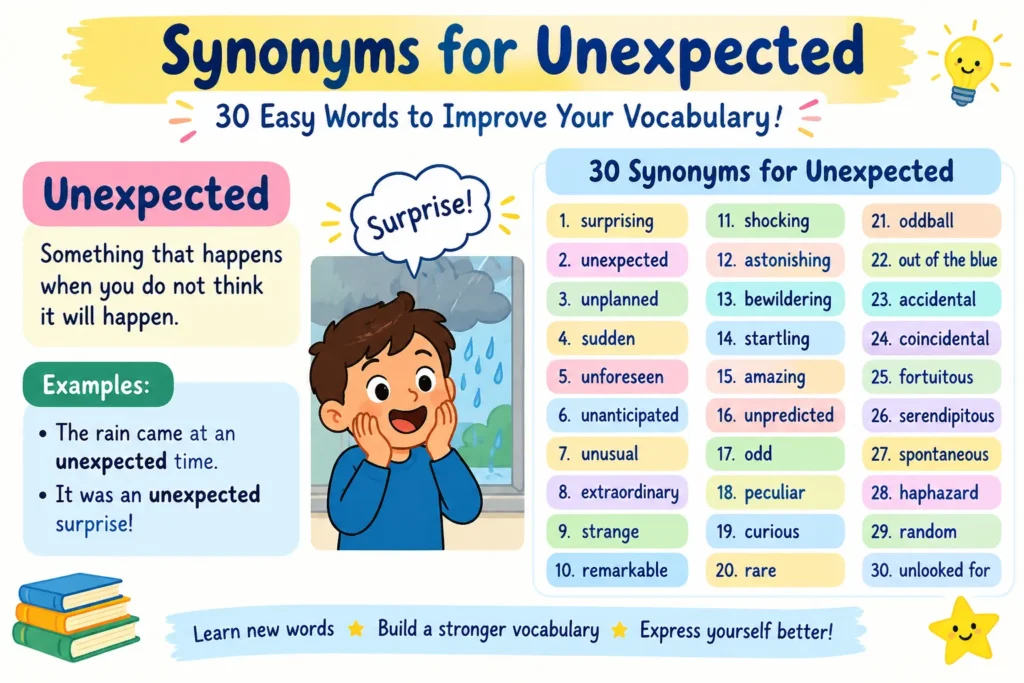
The word unexpected means happening without any warning, planning, or previous thought. Imagine opening your school bag expecting to find your notebook. But finding a surprise birthday card with colorful balloons from your best friend instead. That sudden, surprising event that catches you completely off guard is what we call unexpected.
We use synonyms for unexpected every day to talk. About surprise rain showers, sudden loud noises, pop quizzes, or unannounced visitors. Learning new ways to say unexpected helps make their writing full of excitement, suspense, and wonder. English learner and content writer need synonyms for unexpected too.
This guide gives you 30 simple synonyms for unexpected, along with easy sentences, word origins, pronunciation guides, and clear categories designed just for young learners.
Meaning of Unexpected
Definition
Unexpected (Adjective): Not expected, planned, or foreseen; coming as a surprise.
Examples
- An unexpected rain shower made us run inside.
- She received an unexpected gift from her aunt.
Connotative Meaning
- Positive tone: Shows fun surprises, exciting plot twists, joy, and wonderful gifts.
- Negative tone: Points to sudden accidents, shocks, bad weather, or unwelcome disruptions.
- Neutral tone: Describes random facts, unusual events, or sudden shifts in routine.
Etymology
- Source language: Came from Old English and Latin roots combining un- (not) + expectare (to await or look for).
- Latin: Derived from ex- (out) + spectare (to look at).
- Middle English (1100–1500): Formed as a negative adjective to describe things coming without prior warning.
- Modern English (1500–Present): Used as a standard word for anything surprising, sudden, or unplanned!
Pronunciation
- US: /ˌʌnɪkˈspɛktəd/
- UK: /ˌʌnɪkˈspektɪd/
Syllables
un-ex-pect-ed (4 parts)
Affixation Pattern of Unexpected
- Root: Spect / Expect
- Prefix: Un- (meaning not), Ex- (meaning out)
- Suffix: -ed (makes an adjective)
- Word Formation:
- Noun: Unexpectedness
- Verb: Expect
- Adjective: Expected, Unexpected
- Adverb: Unexpectedly
Synonyms for Unexpected
1. Surprising (Adjective) — US: /sərˈpraɪzɪŋ/ | UK: /səˈpraɪzɪŋ/
Meaning: Causing wonder or astonishment because it was not foreseen.
Examples:
The magic trick had a very surprising ending.
She gave a surprising answer to the teacher’s question.
2. Sudden (Adjective) — US: /ˈsʌdn/ | UK: /ˈsʌdn/
Meaning: Happening quickly and without early warning.
Examples:
A sudden loud noise made the dog jump up.
The bus came to a sudden stop at the corner.
3. Unforeseen (Adjective) — US: /ˌʌnfɔːrˈsiːn/ | UK: /ˌʌnfɔːˈsiːn/
Meaning: Not anticipated or known about beforehand.
Examples:
Due to unforeseen delays, the train arrived late.
They faced an unforeseen problem during the game.
4. Unplanned (Adjective) — US: /ˌʌnˈplænd/ | UK: /ˌʌnˈplænd/
Meaning: Happening without any former preparation or schedule.
Examples:
We took an unplanned trip to the ice cream shop.
Their unplanned meeting turned out to be very fun.
5. Accidental (Adjective) — US: /ˌæksɪˈdɛntl/ | UK: /ˌæksɪˈdentl/
Meaning: Happening by chance rather than design.
Examples:
The spill was purely accidental.
He made an accidental tear in his drawing paper.
6. Unanticipated (Adjective) — US: /ˌʌnænˈtɪsəˌpeɪtəd/ | UK: /ˌʌnænˈtɪsɪpeɪtɪd/
Meaning: Not expected or looked forward to in advance.
Examples:
The team met with unanticipated success in the tournament.
An unanticipated guest arrived at dinner time.
7. Sudden / Abrupt (Adjective) — US: /əˈbrʌpt/ | UK: /əˈbrʌpt/
Meaning: Quick, sharp, and unexpected in manner or movement.
Examples:
The story came to an abrupt end.
He made an abrupt turn on his bicycle.
8. Unpredicted (Adjective) — US: /ˌʌnprɪˈdɪktəd/ | UK: /ˌʌnprɪˈdɪktɪd/
Meaning: Not guessed or stated ahead of time.
Examples:
The unpredicted storm caught the sailors off guard.
Her choice was completely unpredicted.
9. Out of the blue (Idiom/Adjective Phrase) — US: /aʊt ʌv ðə bluː/ | UK: /aʊt ɒv ðə bluː/
Meaning: Happening completely without warning.
Examples:
The phone call came right out of the blue.
She got a postcard out of the blue from her cousin.
10. Startling (Adjective) — US: /ˈstɑːrtlɪŋ/ | UK: /ˈstɑːtlɪŋ/
Meaning: So unexpected that it causes a quick jump or shock.
Examples:
The flash of lightning was a startling sight.
He heard a startling knock on the window.
11. Unscheduled (Adjective) — US: /ˌʌnˈskɛdʒuːld/ | UK: /ˌʌnˈʃedjuːld/
Meaning: Not arranged on a timetable or schedule.
Examples:
The pilot made an unscheduled stop for repairs.
We had an unscheduled fire drill at school today.
12. Shocking (Adjective) — US: /ˈʃɑːkɪŋ/ | UK: /ˈʃɒkɪŋ/
Meaning: Very surprising, alarming, or upsetting.
Examples:
The news brought a shocking surprise to the village.
It was shocking to see how fast the plant grew.
13. Spontaneous (Adjective) — US: /spɑːnˈteɪniəs/ | UK: /spɒnˈteɪniəs/
Meaning: Happening naturally without being rehearsed or forced.
Examples:
The crowd broke into spontaneous applause.
They enjoyed a spontaneous game of tag in the yard.
14. Chance (Adjective) — US: /tʃæns/ | UK: /tʃɑːns/
Meaning: Happening by luck or coincidence.
Examples:
It was a chance meeting at the park.
A chance discovery led them to the lost key.
15. Unlooked-for (Adjective) — US: /ˌʌnˈlʊkt fɔːr/ | UK: /ˌʌnˈlʊkt fɔː/
Meaning: Not waited for or sought after.
Examples:
Winning the prize was an unlooked-for treat.
They received unlooked-for help from a friendly neighbor.
16. Out of nowhere (Idiom/Adjective Phrase) — US: /aʊt ʌv ˈnoʊwɛr/ | UK: /aʊt ɒv ˈnoəweə/
Meaning: Appearing suddenly without any sign.
Examples:
A stray cat appeared out of nowhere.
The ball flew across the field out of nowhere.
17. Unannounced (Adjective) — US: /ˌʌnəˈnaʊnst/ | UK: /ˌʌnəˈnaʊnst/
Meaning: Arriving or happening without telling anyone first.
Examples:
The inspector made an unannounced visit to class.
Our grandparents came over unannounced with treats.
18. Unthought-of (Adjective) — US: /ˌʌnˈθɔːt ʌv/ | UK: /ˌʌnˈθɔːt ɒv/
Meaning: Not imagined or considered as a possibility.
Examples:
Floating on air seemed like an unthought-of miracle.
He came up with an unthought-of idea for the project.
19. Astonishing (Adjective) — US: /əˈstɑːnɪʃɪŋ/ | UK: /əˈstɒnɪʃɪŋ/
Meaning: Extremely surprising and difficult to believe.
Examples:
The magician performed an astonishing card trick.
Her test score showed astonishing improvement.
20. Off-guard (Adjective Phrase) — US: /ɔːf ɡɑːrd/ | UK: /ɒf ɡɑːd/
Meaning: Catching someone unprepared or unaware.
Examples:
The sudden question caught him off-guard.
The pop quiz caught the students off-guard.
21. Casual (Adjective) — US: /ˈkæʒuəl/ | UK: /ˈkæʒuəl/
Meaning: Happening by chance without regular care or intent.
Examples:
They made a casual observation about the weather.
A casual remark led to a fun game idea.
22. Unintended (Adjective) — US: /ˌʌnɪnˈtɛndəd/ | UK: /ˌʌnɪnˈtendɪd/
Meaning: Not planned as a goal or outcome.
Examples:
Laughing was an unintended result of the joke.
The messy room was an unintended mistake.
23. Staggering (Adjective) — US: /ˈstæɡərɪŋ/ | UK: /ˈstæɡərɪŋ/
Meaning: Deeply shocking or overwhelmingly surprising.
Examples:
The bakery sold a staggering number of cookies.
The size of the blue whale was staggering.
24. Unimagined (Adjective) — US: /ˌʌnɪˈmædʒɪnd/ | UK: /ˌʌnɪˈmædʒɪnd/
Meaning: Not thought of as possible before.
Examples:
Space travel brought unimagined wonders to science.
They gained unimagined success with their invention.
25. Extraordinary (Adjective) — US: /ɪkˈstrɔːrdəˌnɛri/ | UK: /ɪkˈstrɔːdnri/
Meaning: Very unusual, surprising, or remarkable.
Examples:
The butterfly had extraordinary colors on its wings.
It was an extraordinary day filled with surprises.
26. Random (Adjective) — US: /ˈrændəm/ | UK: /ˈrændəm/
Meaning: Made or done without a set plan or rule.
Examples:
The computer picked a random student for the job.
She did a random act of kindness for her friend.
27. Fortuitous (Adjective) — US: /fɔːrˈtuːətəs/ | UK: /fɔːˈtjuːɪtəs/
Meaning: Happening by a lucky chance or fortune.
Examples:
Finding a coin on the walk was a fortuitous event.
Their fortuitous meeting solved the problem.
28. Incalculable (Adjective) — US: /ɪnˈkælkjələbl/ | UK: /ɪnˈkælkjələbl/
Meaning: Not able to be predicted or calculated beforehand.
Examples:
The storm caused incalculable changes to the beach.
The book had an incalculable influence on his mind.
29. Eye-opening (Adjective) — US: /ˈaɪ oʊpənɪŋ/ | UK: /ˈaɪ əʊpənɪŋ/
Meaning: Surprising in a way that teaches you something new.
Examples:
Visiting the zoo was an eye-opening experience.
The science experiment gave eye-opening results.
30. Unpromising / Unheralded (Adjective) — US: /ˌʌnˈhɛrəldəd/ | UK: /ˌʌnˈherəldɪd/
Meaning: Arriving without advance praise, warning, or announcement.
Examples:
An unheralded hero stepped forward to save the day.
The small team achieved unheralded victory.
Also read more about https://synonymhubb.com/synonyms-for-due-to/
Prototype Meaning
When children hear unexpected, they picture a thrilling surprise. Like popping open a surprise box, hearing an unannounced knock on the door, or seeing an out-of-the-blue rainbow after sudden rain.
Prototype Categorization
- Surprise & Wonder: Surprising, Startling, Shocking, Astonishing, Staggering, Extraordinary, Eye-opening.
- Without Planning or Schedule: Unplanned, Unscheduled, Spontaneous, Unannounced, Off-guard, Random, Unheralded.
- Sudden & Quick: Sudden, Abrupt, Out of the blue, Out of nowhere.
- Unknown Beforehand & Chance: Unforeseen, Accidental, Unanticipated, Unpredicted, Chance, Unlooked-for, Unthought-of, Casual, Unintended, Unimagined, Fortuitous, Incalculable.
Antonyms of Unexpected
- Expected
- Planned
- Predicted
- Scheduled
- Foreseen
- Regular
Short Questions and Answers
- What does unexpected mean?
- It means happening without any previous warning, planning, or prediction.
- When should I use unexpected?
- Use it when writing about plot twists, sudden events, surprise gifts, or unplanned changes.
- Is unexpected a good or bad word?
- It can be positive (a happy surprise gift) or negative (a sudden storm or accident).
- How is it different from similar words?
- Unexpected means coming without warning, sudden describes how fast it happens, and accidental means it happened by mistake without intention.
Conclusion
Synonyms for unexpected helps make your English writing rich and exciting! Repeating words like “surprising” or “sudden” over and over makes stories feel repetitive. Swapping in energetic phrases like out of the blue for sudden visits, unforeseen for unexpected delays, or spontaneous for fun games will make your essays shine. Try using two or three of these new synonyms for unexpected in your story.

I’m Zahid Abbas, an educator, researcher, and digital publishing strategist with a passion for linguistics, grammar, and clear communication. As a content creator and SEO specialist, I craft research-driven, reader-focused content that empowers learners and makes knowledge accessible worldwide.